
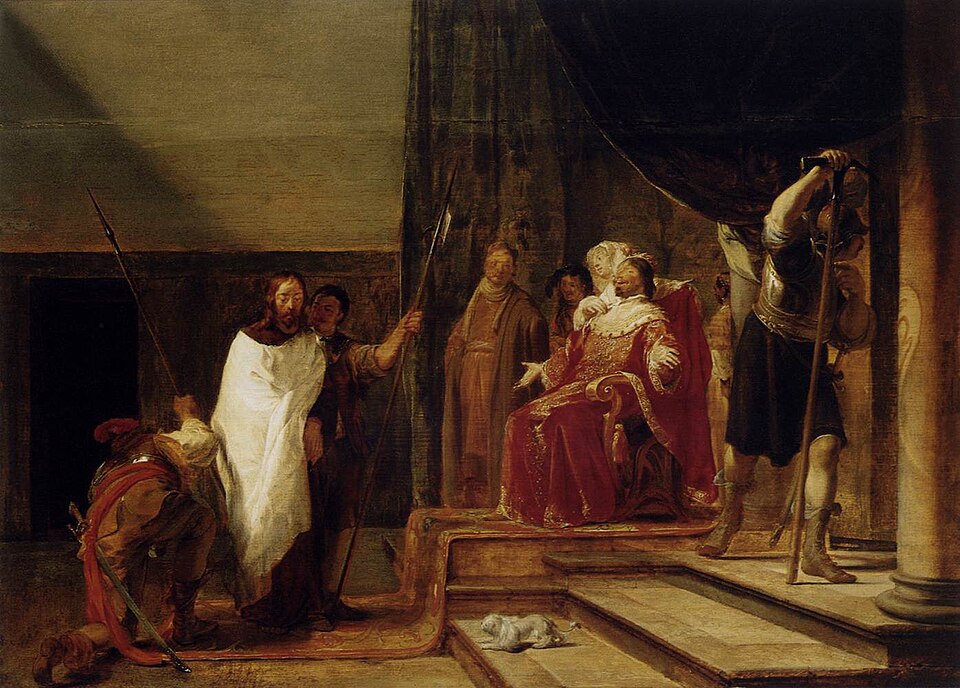
Two Sons of Herod on the Morning of the Crucifixion
On the morning of the crucifixion, according to Luke alone among the evangelists, Pilate interrupted his own trial. The accusers had told him that the prisoner was stirring up the people throughout Judea, “from Galilee where he began even to this place,” and when Pilate heard the word Galilee he asked whether the man was a Galilean. When he learned that the man belonged to Herod’s jurisdiction, he sent him to Herod Antipas, the tetrarch of Galilee, who was in Jerusalem for the feast.[1]
What follows takes six verses. “When Herod saw Jesus, he was very glad, for he had been wanting to see him for a long time, because he had heard about him and was hoping to see him perform some sign. He questioned him at some length, but Jesus gave him no answer. The chief priests and the scribes stood by, vehemently accusing him. Even Herod with his soldiers treated him with contempt and mocked him; then he put an elegant robe on him, and sent him back to Pilate. That same day Herod and Pilate became friends with each other; before this they had been enemies.”[2]
The scene is usually read as a small interlude, a ruler’s idle curiosity disappointed, inserted by Luke to show that two authorities, one Jewish and one Roman, found nothing to condemn. The Gospel as Mirror reads it as something sharper: a meeting between two sons of Herod the Great, one of whom had waited thirty years for the crown his father wore and the other of whom had claimed it. That reading is reconstruction, and I will mark where it starts. The details Luke gives are strange in themselves and repay a slower look.
A Long Time Wanting
Luke does not introduce Antipas’s curiosity on the morning of the trial. He has been building it for fifteen chapters. When the tetrarch heard of everything that was happening in Galilee, Luke says, he was perplexed, because some said John the Baptist had been raised from the dead; and Antipas said, “John I beheaded; but who is this about whom I hear such things?” And he tried to see him.[3] Later, some Pharisees warn Jesus to leave the territory because Herod wants to kill him, and Jesus calls the tetrarch “that fox.”[4] By the time the prisoner is brought before him, Luke has told the reader three times that Antipas wanted to see this man, and the Greek of the trial scene puts the wish in the strongest form, ex hikanōn chronōn, “for a long time.”
A Galilean preacher who had never been arrested in Galilee, whom the tetrarch had tried and failed to see in his own territory for years, would be an unusual object for that kind of persistence. Antipas had the Baptist arrested at Machaerus without difficulty. If he had wanted the Galilean teacher, he governed the country the teacher walked in. The wish Luke describes is less like a ruler’s wish to lay hands on a troublemaker and more like a man’s wish to see, with his own eyes, someone he had heard about and could not reach.
The Man Antipas Had Become
Antipas, the son of Herod the Great by Malthace the Samaritan, had come nearer the crown than any of his surviving brothers. In one of the last versions of his father’s will, made after the condemnation of Antipater, Herod named Antipas king. Days before his death he changed it again, gave the kingship to Archelaus, and left Antipas only Galilee and Perea as tetrarch. Antipas went to Rome to contest the change and lost.[5] He spent the rest of his life as tetrarch, more than forty years, and when he finally went to Rome to ask Gaius for the title of king, his nephew Agrippa, who already had it, sent letters accusing him, and the emperor exiled him to Gaul.[6] Jesus calls him “that fox,” and Josephus calls him a lover of tranquility; the man the two portraits share is a son of Herod who wanted his father’s title all his life and never received it.
When the morning of the trial came, Rome had refused the title of King of the Jews to every one of Herod’s sons, Antipas among them. The prisoner Pilate sent across the city was accused of claiming exactly that title.
Silence, Contempt and a Robe
The prisoner gave Antipas no answer. He had answered Pilate, if only with “You say so,” and he had answered the high priest, but before the tetrarch he said nothing at all, and Antipas questioned him “at some length.” Then Antipas and his soldiers treated him with contempt, mocked him, dressed him in an esthēs lampra, a bright or splendid garment, and sent him back.
The robe has had less attention than it deserves. Luke uses the same adjective in Acts for the shining clothes of the angel who appeared to Cornelius, and the letter of James uses it for the costly clothes of a rich man who enters an assembly with a gold ring on his finger.[7] It is the clothing of rank and splendor, and Luke, who elsewhere describes a Herodian king in his royal robes, chose it here.[8] Roman soldiers in the other Gospels dress the prisoner in purple to mock him as a king. Herod’s own soldiers, in Luke, dress him in the bright clothing of a man of rank, and whether they meant it as mockery, as recognition, or as both at once, Luke does not say.
I find that I cannot settle the meaning of the robe, and I would sooner say so than force it. It may be the Lukan version of the Roman mockery, moved from Pilate’s soldiers to Herod’s. It may be a garment of honor given with contempt, the way a court mocks a pretender by dressing him as what he claims to be. The detail is, either way, a garment that the tetrarch of Galilee put on a man accused of claiming the crown of Galilee’s former king.
Enemies Until That Day
Luke ends the scene with a sentence that has no theological purpose in it: “That same day Herod and Pilate became friends with each other; before this they had been enemies.” Luke does not say why they had been enemies, and two incidents suggest reasons. Luke himself reports that Pilate had killed some Galileans while they were offering sacrifice, mingling their blood with the blood of their offerings, and those Galileans were Antipas’s subjects.[9] Philo reports that when Pilate set up gilded shields in Herod’s palace in Jerusalem, the people protested and were joined by “the four sons of the king,” Herod’s surviving sons, and that they threatened to send an embassy to Tiberius over the governor’s conduct.[10] Antipas was very likely one of the four. A tetrarch who had joined a protest against the governor, and whose subjects the governor had killed at the altar, had reason to be on bad terms with Pilate.
What ended the enmity, on Luke’s account, was the prisoner. Pilate sent him to Antipas, Antipas sent him back, and from that day the two men were friends. A courtesy over jurisdiction might explain a thaw between the two men, though Luke reports something warmer than a thaw, and a friendship begun over a prisoner’s fate asks for a reason the courtesy does not supply.
Doubts About the Scene
Historians have doubted this hearing, and their reasons are substantial. Luke is the only evangelist to report it. He had a reason to compose it, since the second psalm speaks of the kings of the earth and the rulers gathering together against the Lord’s anointed, and in Acts Luke applies the verse to “Herod and Pontius Pilate” by name.[11] Raymond Brown, weighing the scene, allowed that it may preserve a tradition of some Herodian involvement while doubting much of its detail.[12] A reader who concludes that Luke wrote the hearing to fulfill the psalm has a good argument.
Two facts weigh on the other side. The first is that Luke, alone among the evangelists, had sources in Herod’s court, and he names them. Among the women who followed Jesus and supported the company from their own means was Joanna, “the wife of Herod’s steward Chuza,” and among the prophets and teachers at Antioch was Manaen, who had been brought up with Herod the tetrarch.[13] An evangelist with informants in Antipas’s household is the evangelist we would expect to know what happened in Antipas’s presence. The second is that a second-century text, the fragment of the Gospel of Peter found at Akhmim, gives Herod a larger role still: in it, Herod the king gives the order for the execution, and Pilate must ask Herod for the body.[14] The Gospel of Peter is late and dependent, and it cannot be used as independent history. It shows that at least one Christian tradition remembered the death of Jesus as a matter in which the house of Herod had a hand.
Two Sons of Herod
Here the essay crosses into the reconstruction of The Gospel as Mirror. The book argues that the man who died on the cross was Herod, the son of Herod the Great by Cleopatra of Jerusalem, a son Josephus names once and never mentions again, whom the Gospels remember as Jesus Barabbas and Judas Iscariot, and who took the title of the Galilean teacher in Gethsemane. On that reconstruction, the prisoner Pilate sent across the city that morning was Antipas’s half-brother.
On that reading, the scene’s oddities fall into place. Pilate sent the prisoner to Antipas because the title he had been arrested under, Jesus of Nazareth, made him a Galilean on paper. Antipas had wanted to see him for a long time, as a man wants to see a brother who has been out of his reach and has claimed the crown that both of them were denied. The prisoner said nothing to him, which was the one answer that neither admitted nor denied what the half-brother before him knew. Antipas’s soldiers put him in the clothing of a man of rank, which was what he was. And Antipas, who could have released a Galilean subject or kept him, sent him back to the governor who would crucify him, and the two men who had been enemies became friends that day over the fate of a Herodian claimant whose death served them both. The tetrarch was rid of a rival for the title he still hoped to receive, and the governor had the tetrarch’s consent to execute a son of Herod.
None of that is in Luke. What is in Luke is a tetrarch’s long wish, a prisoner’s silence, a splendid robe, and a friendship that began that day, and those four details describe a meeting between two men who knew each other better than the evangelist was willing to say. A reader who rejects the reconstruction can keep them as puzzles. A reader who accepts it will find that they stop being puzzles, and that the short scene in the twenty-third chapter of Luke is the only place in the Gospels where two sons of Herod the Great stand in the same room, and one of them sends the other to his death.
[1]Luke 23:5–7. Biblical quotations follow the New Revised Standard Version unless otherwise noted.
[2]Luke 23:8–12.
[3]Luke 9:7–9.
[4]Luke 13:31–32.
[5]Josephus, Jewish Antiquities 17.146, 188–189, 224–227; Jewish War 2.20–22.
[6]Josephus, Jewish Antiquities 18.240–255.
[7]Acts 10:30; Jas 2:2–3.
[8]Acts 12:21; compare Josephus, Jewish Antiquities 19.344.
[9]Luke 13:1.
[10]Philo, On the Embassy to Gaius 299–305.
[11]Acts 4:25–27, quoting Ps 2:1–2.
[12]Raymond E. Brown, The Death of the Messiah: From Gethsemane to the Grave, 2 vols. (New York: Doubleday, 1994), vol. 1, section on Jesus before Herod.
[13]Luke 8:3; Acts 13:1.
[14]Gospel of Peter 1–5. See Paul Foster, The Gospel of Peter: Introduction, Critical Edition and Commentary (Leiden: Brill, 2010).



Leave a Reply