

Near the cross, the Gospel of John says, stood the mother of Jesus, her sister, Mary the wife of Clopas, and Mary Magdalene. “When Jesus saw his mother and the disciple whom he loved standing beside her, he said to his mother, ‘Woman, here is your son.’ Then he said to the disciple, ‘Here is your mother.’ And from that hour the disciple took her into his own home.”[1] The scene is among the tenderest in the Gospels, and it has been painted, preached and set to music for as long as there has been a Church. It contains one word that has troubled readers for nearly as long. The dying man calls the woman John has just named as his mother gynai, “Woman.”
This essay is about that word. It is spoken to Mary twice in the Gospel of John, at the beginning of the public life and at its end, and nowhere else in the Gospels does a son speak to his mother in either way. The commentators who have studied the address with the greatest care have explained it by theology, and their explanation is a good account of what John meant. It leaves the word itself unexplained, and one of the greatest of those commentators said as much. The argument of The Gospel as Mirror is that the word needs no theology at all. A man who would not call Mary his mother was a man who was not her son.
Twice, and Only to Her
The first time is at a wedding. At Cana in Galilee, John says, the mother of Jesus was present, and Jesus and his disciples were invited. When the wine gave out, his mother said to him, “They have no wine,” and he answered, “Woman, what concern is that to you and to me? My hour has not yet come.” She told the servants to do whatever he said, and he had them fill six stone jars with water, which became wine, and John calls it the first of his signs.[2]
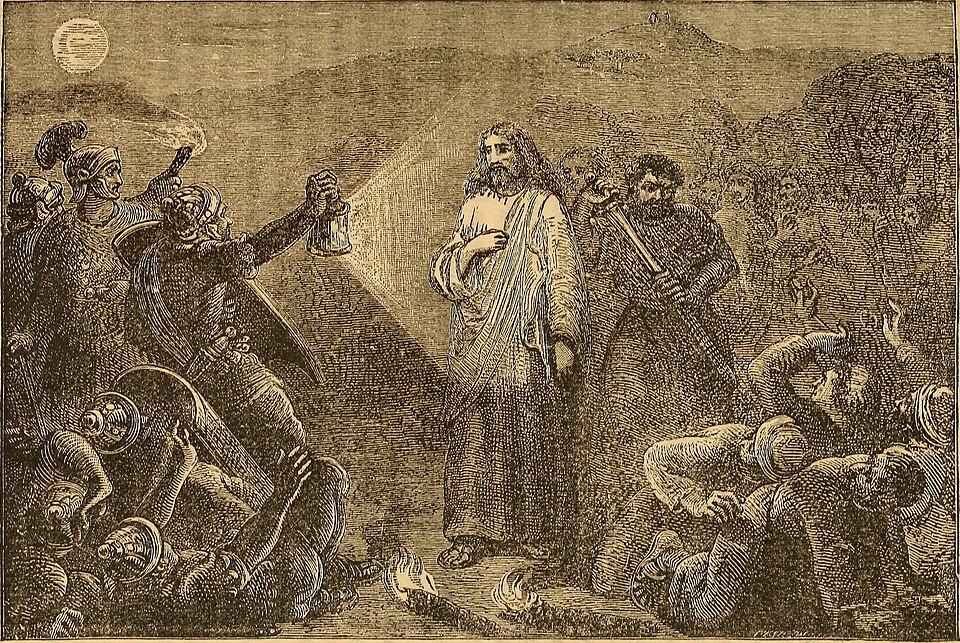
The second time is at the cross, in the scene above. The two addresses bracket the Gospel, the first at the first sign and the second at the death, and both are spoken by the man called Jesus to the woman John calls his mother. In neither does he call her mother. In neither does John comment on the word. A reader moving through the Gospel in order hears “Woman” at the wedding, waits seventeen chapters, and hears it again from the cross, and the evangelist who chose his words with such care that commentators can build arguments on a single preposition chose this one twice.
What a Scholar Conceded
The traditional reading treats gynai as a respectful form of address, and the evidence for that reading is real. Jesus uses the word in the Gospels to the Samaritan woman at the well, to the Canaanite woman whose faith he praises, and to Mary Magdalene at the tomb, and in each case it is courteous. Cassius Dio has Octavian address the defeated Cleopatra with the same word, telling her to take heart, and commentators have long cited the passage to show that the address could be used with respect even to a queen.[3] Translators who render it “Dear woman,” or who say that in English it would be closer to “Madam” or “Ma’am,” are trying to convey that courtesy, and they are right that the word carried no insult.
The evidence stops short at the one point that matters. None of the women addressed as gynai in these passages is the speaker’s mother. Raymond Brown, whose two-volume commentary on John remains the standard work in English and who defended the traditional reading of Cana at length, acknowledged in his note on the verse that he knew of no precedent in Hebrew, nor any he was aware of in Greek, for a son addressing his mother by this word.[4] Brown did not draw the conclusion this essay draws. He drew a theological one, which I set out below. His admission is the starting point all the same, because it comes from a scholar who had every reason to find a precedent if one existed, and it moves the burden of explanation from the reader who finds the word strange to the reading that finds it natural.
The word a son used was available to John. When Telemachus answers his mother in the first book of the Odyssey, he calls her mēter emē, “my mother,” and Greek tragedy is full of sons crying ō mēter.[5] The Greek Bible has a scene uncomfortably close to Cana. When Bathsheba came to King Solomon with a request on behalf of another, the king rose to meet her, bowed down to her, set a throne for her at his right hand, and said, “Make your request, my mother; for I will not refuse you.”[6] A king on his throne, a mother bringing him a request for someone else, and a son who addresses her by the name of the relationship: the scene has every part of the wedding at Cana except the word, and at Cana the word is missing.
The Theological Reading
The traditional interpretation handles the two addresses as stages of a single movement. At Cana, the argument runs, Jesus distances himself from his mother’s claim on him, asserting that his hour is set by the Father and not by family. At the cross, with his hour come, he gives her a new role as the mother of the disciple he loved, and through him the mother of the believing community, so that the second “Woman” restores the relationship the first had set aside, in a transformed and spiritual form. Brown read the address in this way, and some commentators have added that “Woman” recalls Eve, the woman of Genesis, so that Mary at the cross becomes the new Eve standing beside the new Adam.[7]
The reading is beautiful and coherent, and it accounts for the meaning John gave the two scenes. It does not account for the word. A theology of distance and restoration explains why John might have wanted Jesus to address his mother formally. It does not explain why, of all the sons in Greek and Hebrew literature that Brown had read, this one alone used this word to his mother, or why a son restoring his mother to a new and greater place at the moment of his death would do so without once calling her by the name of the relationship he was transforming. The theology tells us what the scenes mean in the Gospel, and it leaves standing, untouched by any of that meaning, the word no son used.
A Man Who Could Not Call Her Mother
The reading this essay offers is simpler. The man who addressed Mary as “Woman” at Cana and at the cross did not call her mother because she was not his mother. The address is the one a man would use to a woman he honored and was not related to, and it was used twice because the same man spoke both times.
That reading belongs to the reconstruction of The Gospel as Mirror, and a reader should know its outline. The book argues that two men stand behind the Gospel figure of Jesus: a young Galilean teacher, whose mother was Mary, and a royal claimant, Herod, the son of Herod the Great and Cleopatra of Jerusalem, whom the Gospels remember as Jesus Barabbas and Judas Iscariot. On the book’s reading, the claimant died on the cross under the teacher’s name. At the cross, then, the dying man was the claimant and the woman before him was the mother of the teacher whose title he bore. He could not call her mother without making a claim that was false, and the word he used was exact.
The same reading places the claimant at Cana, and the decision has to be defended, since the first edition of the book made it with too little argument. Three things point to him. The saying “My hour has not yet come” refers, throughout John, to the hour of the death, and the man whose death it was is the claimant.[8] The wedding is followed immediately by the violent scene in the Temple, in which Jesus drives out the money changers with a whip, and the book assigns that act to the claimant, so that John’s second chapter opens with two scenes belonging to the same man.[9] And the address at Cana matches the address at the cross, spoken on this reading by one man to one woman, who had a part in his life and was not his mother. Volume Four of the series, The Syntrophos Principle, argues that the claimant and the teacher were bound together from early life, which would make Mary’s presence at a wedding with the claimant and her request to him unremarkable. For this essay the point is narrower: a woman can ask a favor of a man who is not her son, and that the man can grant it.
The Narrator and the Speaker
John’s narration calls Mary “the mother of Jesus” at Cana, twice, and after the wedding it says that “he went down to Capernaum with his mother, his brothers, and his disciples.”[10] The reading of this essay has to account for that, and it does so by a distinction the method of the book depends on. The narrator wrote of the woman as the mother of Jesus because she was the mother of the Jesus whose name the Gospel bore, and in the merged memory from which John wrote, the two men had become one. The speaker in the scene, whose words the tradition preserved, used the address that was true of himself. The hermeneutic of inversion treats such a difference between what a narrator says and what a character says as a seam, and in this case the seam runs between the narrator’s “mother” and the speaker’s “Woman.”
An objection arises from within the book’s own argument, and a careful reader will raise it. The Gospel as Mirror assigns to the Galilean teacher the sayings in which Jesus sets aside family ties, among them the question in Mark, asked when his mother and brothers came to take him home: “Who are my mother and my brothers?” He looked at those around him and said that whoever does the will of God is his brother and sister and mother.[11] A reviewer could read the Cana address as one more instance of that distance, and conclude that the woman at Cana was the teacher’s own mother and the speaker the teacher himself. The two scenes differ in kind. In Mark the teacher speaks about his mother to a crowd, and he makes a statement about kinship, redefining it around the will of God. At Cana the speaker addresses the woman to her face, in a scene where she asks for help and he, after demurring, gives it. The Markan saying is a teaching about who counts as kin, while the Cana address is a form of speech between two people, in a form that, on Brown’s survey, no son used to his mother.
Here Is Your Son
The words at the cross, read without the traditional theology, are a father’s provision for his son. “Woman, here is your son” commits the young man standing beside her to her care. “Here is your mother” tells the young man that she will be to him what his own mother could not be. And John says that from that hour the disciple took her into his own home, eis ta idia, the phrase John used in his prologue for the Word who “came to his own, and his own people did not accept him.”[12] The Gospel opens with a man whose own did not receive him and closes its account of the cross with a young man receiving a woman into his own.
The traditional reading, in which the dying Jesus provides for his widowed mother by giving her to his closest disciple, has always had a difficulty commentators have noticed. The Gospels say Jesus had brothers, and Mark names four of them.[13] A son dying with living brothers would ordinarily have left his mother to them, and the usual explanations, that the brothers did not yet believe or that they were half-brothers or cousins, have been debated for centuries. On the reading of this essay, the difficulty disappears. The man on the cross was not her son, and the provision he made was for his own. The book identifies the disciple whom Jesus loved with Herodion, the claimant’s son, whom Paul greets in Romans as his kinsman and whom the Gospel of John never names, and that identification is the subject of its own essay. Here the words themselves carry the point: a dying man gives a young man and a woman to each other, and the young man takes her home.
What the Word Shows
At the source tier, John records that Jesus addressed Mary as “Woman” twice, at Cana and at the cross, and never as mother; Jesus uses the same word courteously to other women in the Gospels; the Greek and Hebrew traditions gave sons the word “mother” for their mothers, as Telemachus and Solomon use it; and Raymond Brown, defending the traditional reading, knew no precedent for a son calling his mother “Woman.”
At the inference tier, the address is anomalous for a son speaking to his mother, and the theological reading explains the meaning of the two scenes without explaining the anomaly.
At the reconstruction tier, the man who spoke at Cana and at the cross was the claimant, Herod son of Cleopatra, who honored the teacher’s mother and was not her son; at the cross he gave his own son into her care; and John’s narration, which calls her the mother of Jesus, is the surface of a memory in which two men had become one, while the speaker’s word preserved what was true of the man who spoke it. A reader who rejects the reconstruction keeps Brown’s admission and the theology that answers it. A reader who accepts it has an explanation for the word that needs no theology at all, since on that reading the address no son used to his mother was used by a man speaking to a woman who had never been his mother, in the hour he gave her his son.
[1]John 19:25–27. Biblical quotations follow the New Revised Standard Version unless otherwise noted.
[2]John 2:1–11; the quotation is from 2:3–4.
[3]John 4:21; Matt 15:28; John 20:13, 15; Cassius Dio, Roman History 51.12.5.
[4]Raymond E. Brown, The Gospel According to John I–XII, Anchor Bible 29 (New York: Doubleday, 1966), note on John 2:4. Brown’s statement is paraphrased here; the exact wording should be checked against the printed note.
[5]Homer, Odyssey 1.346.
[6]1 Kgs 2:19–20.
[7]Brown, John I–XII, comment on John 2:1–11; compare Gen 3:15, 20.
[8]John 7:30; 8:20; 12:23, 27; 13:1; 17:1.
[9]John 2:13–17.
[10]John 2:1, 3, 12.
[11]Mark 3:31–35.
[12]John 19:27; 1:11.
[13]Mark 6:3; John 2:12; 7:3–5.


Leave a Reply