
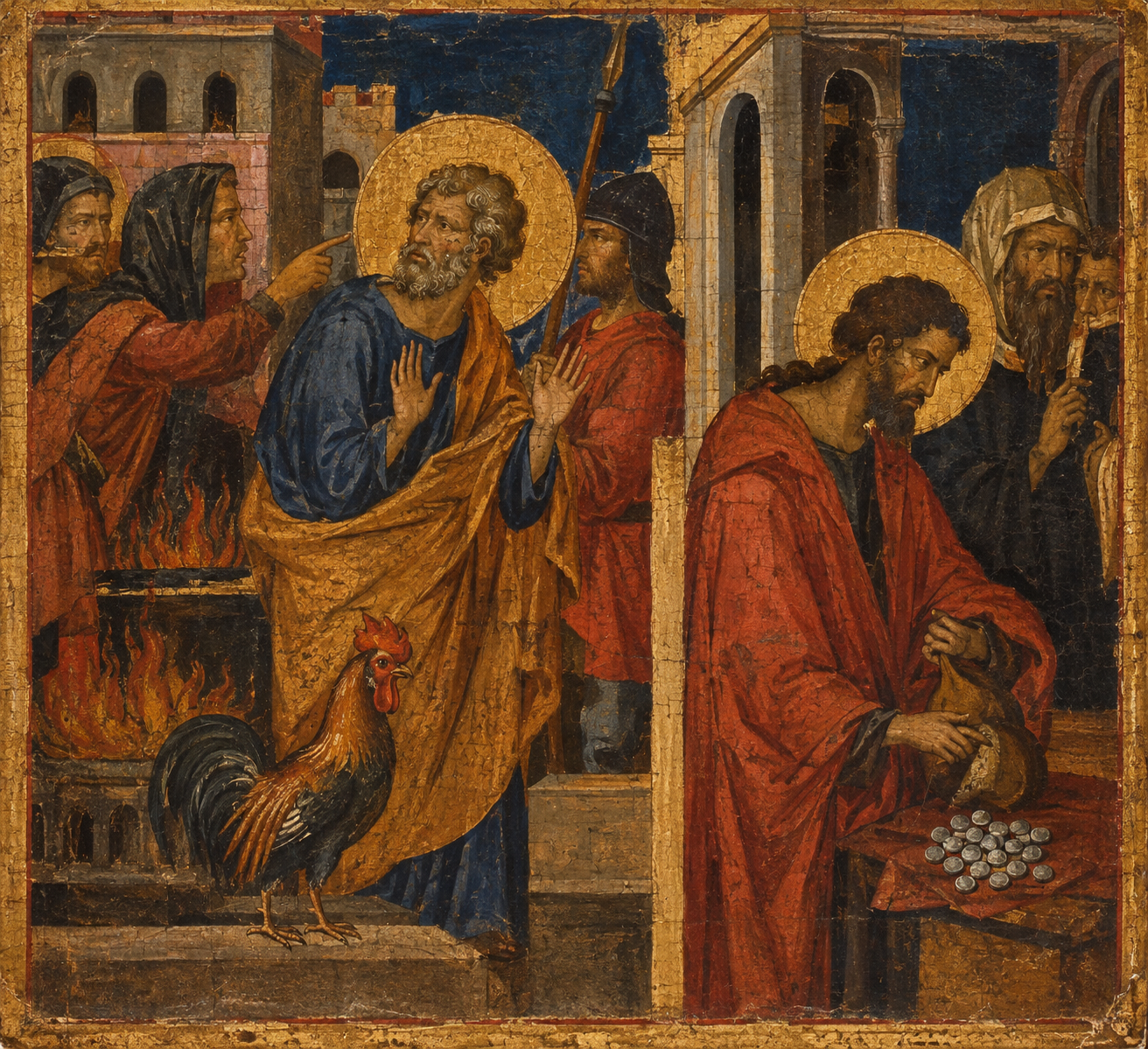
Christianity made one of them a saint and the other a synonym for treachery.
Peter became the rock on which the Church was built, the first pope in Catholic tradition, the apostle whose martyrdom in Rome sealed his place among the great venerated figures in the history of the faith. Cathedrals were named for him. His feast day falls on June 29. Michelangelo painted his crucifixion upside down on the walls of the Pauline Chapel in the Vatican. His keys appear on the papal coat of arms. He is, by any institutional measure, honored above nearly every other human figure in the history of Christianity after Jesus himself.
Judas became the word for betrayal. His name entered every European language as the designation for intimate treachery. Dante placed him in the lowest circle of hell, in the central mouth of Lucifer himself, alongside Brutus and Cassius as history’s three great traitors. Medieval artists gave him red hair and a yellow robe, the visual code for cowardice and deceit. Parents did not name sons after him for two thousand years. His thirty pieces of silver became the permanent symbol of a conscience purchased cheaply and a loyalty sold for profit.
I want to hold the two gospel narratives up against each other, in the same night, under the same pressure, and ask a plain question: does the textual evidence actually support the weight the tradition placed on each man? On close inspection, the disparity between these two fates is one of the more striking moral inversions in the history of Western culture, because the weight of the two acts, examined in the text itself, is not what two thousand years of reception has made of it.
What Peter Actually Did
The denial narratives appear in all four gospels, which makes them among the more widely attested events in the Passion account. The outline holds steady across all four: after Jesus was arrested and taken to the high priest’s courtyard, Peter followed at a distance, positioned himself among the guards warming themselves at the fire, and was identified three times as a follower of Jesus by bystanders, and denied it three times.
Mark’s account, the earliest, is also the more forensically precise of the four. The first denial comes from a servant girl of the high priest, who sees Peter warming himself and says, “You also were with the Nazarene, Jesus.” Peter’s answer is categorical: “I neither know nor understand what you mean” (Mark 14:67-68). This is not a hesitant deflection or an ambiguous non-answer. It is a direct denial of knowing the man on trial for his life upstairs.
The second denial comes when the same servant girl sees him again and tells the bystanders, “This man is one of them.” Peter denies it again (Mark 14:69-70). The third escalates. The bystanders press him: “Certainly you are one of them, for you are a Galilean.” Mark records that Peter “began to invoke a curse on himself and to swear, ‘I do not know this man of whom you speak’” (Mark 14:71).
Three features of that third denial deserve attention the tradition has not given them, because looking closely at them complicates the moral calculus considerably.
Peter invoked a curse on himself. The Greek is anathematizein, to place oneself under a binding curse, calling down divine condemnation if the accompanying statement is false. This is not social pressure producing reluctant evasion. It is a deliberate, formal, religiously weighted act of self-cursing in support of a lie. Peter asked God to judge him if he was lying, while lying.
Peter swore. The Greek is omnuein, to take an oath, to make a formal sworn statement. This was denial reinforced by a sworn oath, the two acts bound together. The Sermon on the Mount, the teaching attributed to Jesus in Matthew 5:33-37, prohibits oath-taking outright: “You have heard that it was said to those of old, ‘You shall not swear falsely.’ But I say to you, do not swear at all… Let what you say be simply ‘Yes’ or ‘No’; anything more than this comes from evil.” Peter broke this teaching in the very act of denying the teacher who gave it, reaching for a formal, binding verbal instrument, the strongest available in first-century Jewish culture, to deny knowing Jesus, at a moment when Jesus’s life depended on the loyalty of those who knew him.
He denied him three times. And he did it under no mortal threat. The people questioning him were a servant girl and a handful of bystanders, not Roman soldiers conducting a formal interrogation. He denied him in the courtyard, warming himself at the fire, among the people who had arrested his teacher, in conditions that were uncomfortable and socially awkward but nothing like the conditions of physical danger that would make the denial comprehensible as self-preservation rather than abandonment.
He denied him in public, in front of multiple witnesses, under oath, invoking God’s curse on himself as the guarantee of the lie.
Matthew 26:74-75 adds that after the third denial, the rooster crowed and Peter remembered Jesus’s words: “Before the rooster crows, you will deny me three times.” He went out and wept bitterly. That weeping is the tradition’s principal evidence for Peter’s repentance and the foundation of the restoration narrative in John 21. But the weeping came after, not during. During the denials themselves, the text shows no internal conflict, only escalation: each denial more formal and more emphatic than the last, the curse and the oath and the flat, repeated claim, I do not know this man.
What the Gospel Text Says Judas Did
The tradition’s account of Judas is familiar to the point that it can be recited without opening a Bible: he went to the chief priests and offered to hand Jesus over for thirty pieces of silver, identified him for the arrest party with a kiss, and later hanged himself in remorse when he understood what he had done.
The Gospel as Mirror argues at length that this account is the product of what the book calls the hermeneutic of inversion, a protective encoding strategy through which the gospel writers preserved the historical reality of the Gethsemane transfer while inverting its moral value to conceal its actual nature. I have made the full case for the pequddah transfer reading across the preceding chapters and will not repeat it here. What this essay can do is examine what the gospel text actually says about Judas’s act, apart from the interpretive overlay the betrayal framework imposes, and set that examination beside the same examination of Peter’s denials.
The Greek word for what Judas did is paradidōmi, to hand over, to deliver, to transfer custody. Everywhere else the word appears in the New Testament, it is morally neutral or positively weighted: Paul handing over the Lord’s Supper tradition in 1 Corinthians 11:23, the apostles delivering the Jerusalem council’s decisions in Acts 16:4, God handing over his own Son in Romans 8:32. The moral freight English translations load onto every Judas passage comes from the interpretive tradition’s decision about what the word must mean here, not from the word itself.
The sum, thirty pieces of silver, has always seemed a strange bribe for information leading to an arrest. Josephus documents informers in first-century Judea receiving considerably larger rewards for intelligence leading to comparable arrests. Thirty pieces of silver corresponds precisely to the sum Exodus 21:32 sets as legal compensation for a life formally transferred from one party to another, a ritual payment marking a covenantal transfer rather than a bribe, the recompense that accompanied what this book calls a pequddah transaction.
The kiss, as Mark 14:44 records it, comes with an instruction to lead the marked man away asphalōs, safely, protected from harm. That instruction, as Chapter Five of this book establishes through the word’s use elsewhere in the New Testament, reads as the language of someone arranging protection rather than arrest.
Matthew 26:50 records Jesus’s response to Judas in the garden: “Friend, do what you came to do.” The Greek word rendered “friend” is hetaire, an associate, a companion in a shared undertaking, a term of real relationship rather than ironic distance. Jesus does not say “traitor” or “enemy,” or even the neutral “companion.” He says hetaire, friend, collaborator, the one who shares his understanding of what the moment requires.
And John 13:27, the moment at the Last Supper when Jesus identifies the one who will hand him over and then tells Judas, “What you are about to do, do quickly.” This is not a resigned acceptance of inevitable betrayal. It is an instruction. The word poiei is the imperative form of “to do,” a direct command to proceed. Jesus is telling Judas to act, to carry out the plan, to perform the paradidōmi without delay.
“Do what you came to do.” “Do it quickly.” This is the language of a man who has arranged something with a trusted collaborator and is now telling that collaborator that the moment has come and any hesitation should be set aside.
The Pre-Knowledge Problem
Jesus predicted both actions in advance, and this is where the moral comparison gets philosophically harder, and where the tradition’s differential treatment of the two men reveals its sharpest inconsistency.
Matthew 26:21-25 records the prediction at the Last Supper that one of the twelve would hand Jesus over. The disciples respond with distress, each asking, “Is it I?” Jesus identifies the one who dips with him in the dish as the one of whom it is written that he would be handed over, and adds the woe statement: “Woe to that man by whom the Son of Man is betrayed! It would have been better for that man if he had not been born.” He then confirms Judas’s identification when Judas himself asks, “Is it I?” and Jesus answers, “You have said so.”
Mark 14:30 records the prediction of Peter’s denial: “Truly I tell you, this very night, before the rooster crows twice, you will deny me three times.” The prediction is direct, exact, and unambiguous. Peter’s denial is foreknown in exactly the sense that Judas’s act is foreknown. Both are predicted by Jesus before they happen. Both are framed as scripturally necessary. Both are presented as part of the events that had to occur for the Passion to unfold as the tradition requires.
The tradition has used Jesus’s foreknowledge of Judas’s act to argue that Judas’s sin was especially terrible: he knew that Jesus knew, and he went ahead anyway, which makes the act deliberate in about as premeditated a sense as the text allows. But the same reasoning applies to Peter. Peter knew that Jesus had predicted his denial. Jesus said it at the table, Peter heard it, Peter protested (“Even if I must die with you, I will not deny you”), and then denied him three times under oath in the courtyard.
If foreknowledge of Jesus’s prediction makes Judas’s act more culpable, the same reasoning makes Peter’s act more culpable. Peter had been warned outright. He had heard the exact prediction of what he would do. He had insisted he would not do it. And then he did it three times, each denial more formally binding than the last, invoking God’s curse on himself as the guarantee of the lie.
I do not think the tradition’s differential treatment of these two foreknown acts follows from the evidence itself. Once the tradition’s prior verdict is set aside, the comparison produces an assessment in which Peter’s act is harder to defend than Judas’s on nearly every count.
Moral Weight: A Comparative Analysis
The two acts can be set side by side across the dimensions moral analysis usually examines: the nature of the act, the intent behind it, the circumstances of its commission, the consequences it produced, and the actor’s response afterward.
The nature of Judas’s act, read through the pequddah framework this book has argued for, was the covenantal transfer of a public identity from one person to another under conditions of mutual agreement and shared purpose. The nature of Peter’s act was the public denial, under sworn oath, of personal knowledge of a man, in circumstances where the denial was not required for his own safety.
The intent behind Judas’s act, on the paradidōmi reading, was protection of the Teacher through the assumption of the Teacher’s legal exposure. The intent behind Peter’s act was self-preservation under conditions of social discomfort, not mortal threat, since no one was arresting or threatening him; the pressure he faced was the social risk of being named among the followers of a man currently on trial.
The circumstances of Judas’s act included a direct instruction from Jesus, “do what you came to do,” “do it quickly,” and whatever necessity the pequddah transfer carried within the plan the two men had arranged. The circumstances of Peter’s act included a prior warning from Jesus, a formal oath-swearing context that raises rather than lowers the moral weight of the denial, and multiple witnesses whose presence made the denial as public as a denial could be.
The consequences of Judas’s act, on the substitution reading, were the Teacher’s survival and the transmission of the tradition, purchased at the cost of Judas’s own life and reputation. The consequences of Peter’s act were the public denial of his teacher at the point of that teacher’s greatest exposure, the abandonment of a man he had sworn never to abandon, and, incidentally, social cover for the arrest party, since Jesus’s own closest follower would not admit to knowing him.
The two men’s responses afterward are where the tradition departs furthest from what the text supports. According to Matthew 27:3-5, Judas was seized with remorse when he saw that Jesus was condemned, returned the thirty pieces of silver to the chief priests with the declaration “I have sinned by betraying innocent blood,” and then hanged himself. The tradition reads the suicide as final confirmation of guilt, the act of a man too crushed by his own sin to go on living. But the remorse, the returned silver, and the declaration of innocent blood betrayed are equally readable as the response of a man who had discovered that the plan had gone wrong in ways he had not anticipated, or as grief, real and overwhelming, at the death of someone he had loved and served. This reads less, on that view, like the grief of a traitor savoring his success and more like the grief of a man who had taken part in something that cost the person he cared for everything.
Peter, by contrast, wept bitterly after his denial (Matthew 26:75) and was later restored in John 21’s threefold commission, feed my lambs, tend my sheep, feed my sheep, the pastoral charge that became the foundation of the apostolic authority the tradition built on his witness. The restoration is presented as complete and unconditional: the triple commission answers the triple denial, and the man who swore under oath that he did not know Jesus becomes the rock on which the Church is built.
I do not think the moral weight of the two acts explains this disparity in outcome. It looks, instead, like the product of institutional need: a movement that had built itself on Peter’s witness needed Judas to be the villain, so that the crucifixion could be explained without implicating the movement’s own failures of loyalty, courage, and nerve.
The Question of Sin: Which Act Was Greater
The tradition’s answer has always been Judas, and that answer has been shaped by two thousand years of institutional need for a single villain, one whose treachery explains the crucifixion as the product of external evil rather than the product of ordinary human failure, including the failure of the movement’s own members, its future leader among them, to stand by the man whose teaching they would later be commissioned to carry forward.
The evidence’s answer is more complicated, and answering it requires separating what the pequddah reading claims about Judas’s act from what the plain gospel text establishes about Peter’s.
If the pequddah reading is correct, if what Judas did was a covenantal transfer arranged between him and the Teacher, carried out on the Teacher’s own instruction, for the purpose of protecting the Teacher’s life and the movement’s future, then Judas did not sin in any conventional sense. He carried out a role he had accepted, under mutual agreement, for the benefit of the man the tradition says he betrayed. The moral weight traditionally assigned to his act gives way, on this reading, to a different weight altogether: the weight of sacrifice rather than treachery, of a man who accepted the role of son of perdition knowing the cost and judging it a fair price for what it purchased.
Even granting the betrayal framework for argument’s sake, accepting that Judas did what the surface narrative says, that he betrayed Jesus for thirty pieces of silver with no prior arrangement or shared purpose, the comparison with Peter still runs against Peter once we look at what was actually at stake in each man’s act.
On the betrayal reading, Judas handed Jesus over to the authorities. He did not deny knowing him. He did not swear under oath that he had no connection to the man. He did not call down God’s curse on himself as the guarantee of a public lie. He made a decision, a disastrous one on this reading, and acted on it out of whatever mixture of motives the tradition has always found insufficient to fully explain. He took money for his information, which is morally damning. He supplied the identification that let the arrest proceed, which makes him causally responsible for the arrest in a way Peter’s courtyard denial was not.
But Peter’s act came after the arrest. The arrest was already accomplished. Jesus was in custody, and the trial was underway. Nothing Peter said or did in that courtyard had any causal bearing on what was happening to Jesus upstairs. His denial did not contribute to the Passion’s outcome. It was an abandonment, public, sworn, and self-cursed, of a man already in custody, in a situation where the denial served only Peter’s own comfort and demonstrated to anyone watching that the movement’s foremost member would not admit to knowing the man on trial.
The act the tradition assigned to Judas, handing Jesus over, had real consequences for the Passion’s events. The act Peter actually committed, denying under oath in public that he knew the man about to be crucified, had none, and served no purpose beyond his own protection.
And Peter had been warned. Jesus told him at the table exactly what would happen. Peter swore it would not. The distance between the promise made at the table and the oath sworn in the courtyard is the distance between who Peter believed himself to be and who he turned out to be under the comparatively mild pressure of a servant girl’s question at night.
What the Tradition Required and What the Evidence Shows
The tradition needed a villain whose act would explain the crucifixion as deliberate human treachery set against divine innocence. Judas served that need well: his act came before the arrest, his motive was nameable (thirty pieces of silver), his method was viscerally repellent (a kiss used as identification), and his end, suicide, could be read as the judgment his guilt deserved. The tradition needed Judas to carry maximal guilt, because his guilt absorbed guilt that would otherwise have had to be distributed across the rest of the movement, Peter included, and the other disciples who fled Gethsemane, and every later member of the Church who ever abandoned a commitment under pressure.
Peter’s rehabilitation served a different institutional purpose. A movement that had built itself on Peter’s witness needed his denial to be forgivable, restorable, the kind of failure the risen Christ’s grace could reach and reverse. The triple commission in John 21 is both a restoration story and an act of institutional legitimation: the man who denied Jesus three times is restored three times and handed the pastoral leadership that became the foundation of apostolic authority. Peter’s failure, far from disqualifying him, becomes proof that leadership survives even the worst kind of human failure, provided grace is available to restore it.
The tradition needed both things at once, a maximally guilty Judas to explain the crucifixion and a restorable Peter to legitimate the leadership built on its aftermath. I think the moral disparity the tradition produced between the two men owes more to those institutional needs than to the evidence itself.
Once those needs are set aside, the evidence shows two men who both failed on the same night, one required by the tradition to be unforgivable and one required to be restorable, and the difference in how they were treated tells us more about what the movement needed than about what either man actually did.
The Reading The Gospel as Mirror Offers
My reading of Judas’s act sets aside the betrayal framework for the pequddah transfer framework, in which Judas protected Jesus rather than betrayed him, acted from covenantal obligation rather than greed, and, rather than identifying Jesus for arrest, assumed Jesus’s identity and walked into arrest in his place.
On this reading, the comparison between Judas and Peter has less to do with betrayal and denial, or with treachery and ordinary human weakness, than with sacrifice and abandonment: the sacrifice belongs to Judas, and the abandonment belongs to Peter.
Judas gave up everything he had, his name, his story, his future, his life, his reputation across two thousand years of cultural memory, so that the Teacher could survive and the tradition could be carried forward. He did it on Jesus’s own instruction. He knew what it would cost him. He paid the full cost, and the tradition built on the survival his act purchased made him its greatest villain rather than its greatest witness, because acknowledging what he had actually done would have meant acknowledging the substitution the composite Christ was built to conceal.
Peter swore in God’s name that he did not know the man whose teaching he would spend the rest of his life carrying forward. He did it three times. He called down God’s curse on himself as the guarantee of the lie. He did it in public, at the exact moment when the man he was denying needed, more than at any other point, the loyalty of those who knew him. Afterward he wept, was restored, and became the rock.
Apart from the institutional needs that shaped the tradition’s treatment of them, the moral balance of these two acts does not fall where the tradition requires it to fall. The evidence places it, instead, on the man who swore under oath in public that he did not know the Teacher, while the man who had accepted the role of the son of perdition was already in custody, dying in the Teacher’s place so that the Teacher could survive to commission Peter to feed his sheep.
Jesus foreknew both acts. What he said to each man differed. He told Judas to do what he had come to do. He told Peter what Peter would do before the rooster crowed twice, as a warning rather than an instruction, and Peter, having sworn he would not, went and did exactly what he had been warned against.
Judas carried out what he was told and died for it. Peter ignored what he was warned of, fulfilled the warning anyway, wept, and was restored to lead the Church that later called Judas its greatest traitor and Peter its first pope. If the reading offered here is right, the tradition inverted the two men almost precisely: it built its authority on the apostle who broke his word under oath, and it built its central villain out of the one who kept his.
Leave a Reply