
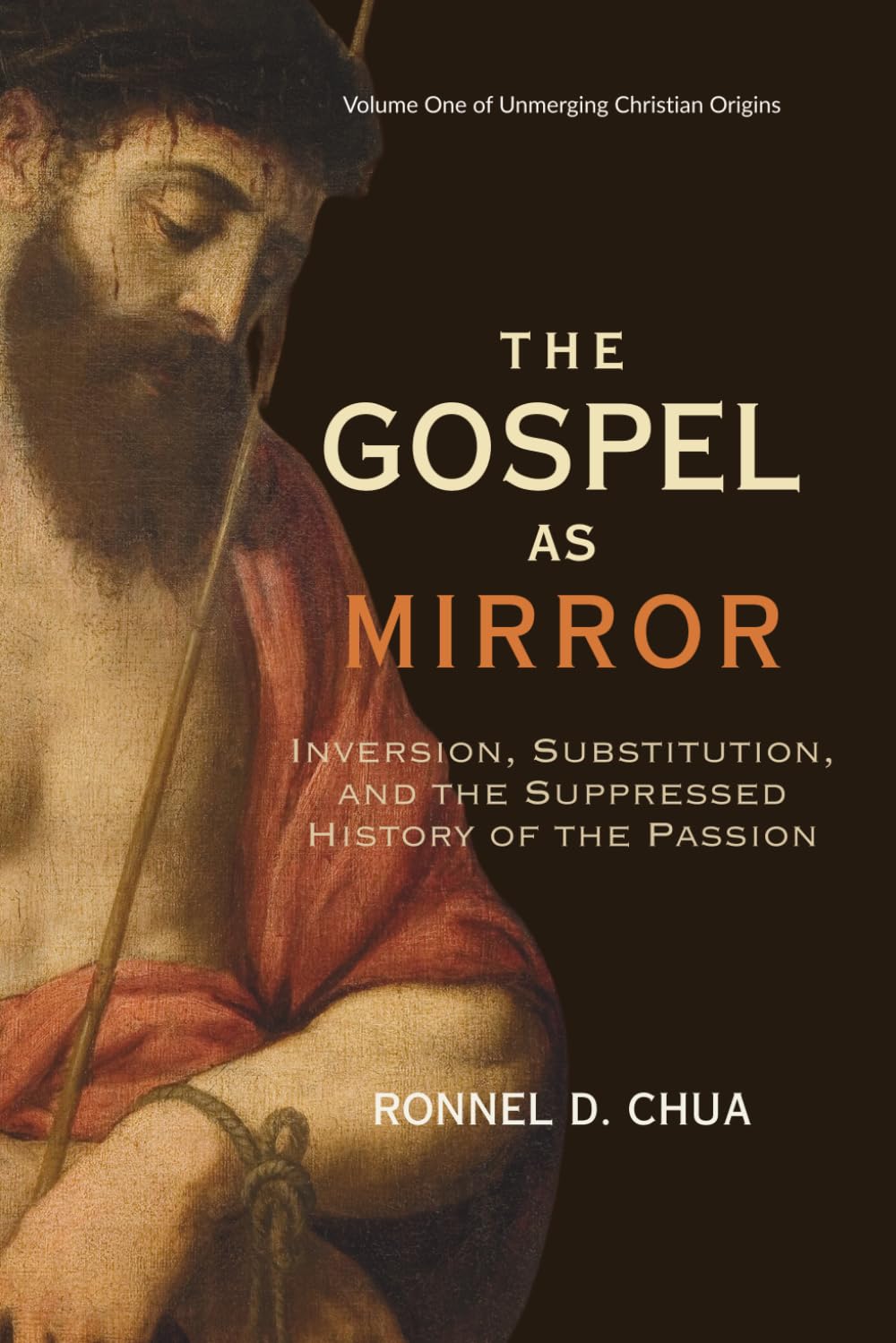

There is a question Matthew’s Gospel raises and then buries under one of the more elaborately constructed evasions in early Christian literature.
Who was the child?
The question is about the particular human child whose birth Matthew describes through a cluster of astronomical strain, diplomatically implausible behavior from the magi, a massacre no other source records, and a prophecy applied to an event it was never written to predict, not about the eternal Son the angels announce and the magi seek in Matthew’s theological frame. That cluster of strain is the kind of thing that, in my reading, marks a text encoding something it could not state outright rather than simply getting its facts wrong.
I think the answer Matthew could not give outright, and that the tradition spent two thousand years discouraging anyone from pursuing too far, is a son of Herod the Great. The case for this, built across The Gospel as Mirror, rests on Josephus’s unexplained silence about one of Herod’s sons, an astronomical convergence around a birth date, an Old Testament citation that permits a more literal reading than the standard typology allows, and an unexplained financial connection between the Jesus movement and Herod Antipas’s own household. None of these pieces proves the identification on its own, and the weight each piece can bear differs quite a bit, a difference I would rather leave exposed than conceal for the sake of a cleaner argument.
This claim rests on a reading of sources available to anyone rather than on hidden documents or suppressed archives, sources the tradition has consistently explained away as legend, symbolism, or carelessness, without ever quite accounting for how much explaining those explanations require.
Why Matthew Could Not Say It Outright
The reason Matthew encoded the Radical’s origins in inverted form rather than stating them outright has to do with what a direct statement would have cost him.
Matthew likely wrote in the 80s CE, in the decade after the Jewish revolt of 66-70 CE ended with Jerusalem destroyed, the Temple burned, and the last significant Herodian ruler, Agrippa II, siding with Rome against the Jewish rebels throughout the war. For critics of the dynasty, that collaboration confirmed a long-standing suspicion: that Herodian rule had never been strategic accommodation to Roman power but subordination to Roman interests at the cost of Jewish sovereignty.
The dynasty that had rebuilt the Temple to claim a kind of restorationist legitimacy had presided over its destruction. For Jewish audiences in the 80s, the Herodian name carried the weight of a historical betrayal rather than a literary one: the betrayal of a people by the family entrusted with their central religious institution.
A movement naming Jesus as Herod’s son in that decade would have paid a dear cost among Jewish converts, who would have been asked to accept as their Messiah the son of the man they blamed for the Temple’s fall. For Roman readers the problem cut the other way: a legitimate claimant to a client throne who had turned his popular following against the system that produced him was exactly the kind of figure Rome’s administration existed to identify and remove, and Rome had already crucified him once for that combination of royal blood and popular appeal. An open connection risked drawing continued Roman attention to a movement still finding its footing after the revolt.
Matthew needed a Jesus whose origin was theologically compelling and politically safe. I think he solved that problem by inverting the truth rather than omitting it, encoding the history in a form hostile readers could not prosecute and that patient readers might eventually work back out.
Inversion as a Protective Technique
The reading method this argument depends on, developed across The Gospel as Mirror, treats certain gospel passages as texts that preserve dangerous facts by reversing their moral charge rather than deleting them. Matthew’s nativity, on this reading, applies that method about as fully as any passage in the New Testament.
Herod as father becomes Herod as threat. The connection between the child and the royal household stays in the story, but its character flips from paternal to adversarial: the child becomes the one Herod hunts rather than the son Herod fathered.
Egypt as birthplace becomes Egypt as refuge. The Egyptian connection stays, down to the citation of Hosea 11:1, but the direction reverses. The child does not come from Egypt; he flees to it.
The magi as court specialists become foreign seekers. Their profession stays intact in the text, since magos is the standard term for a Persian or Babylonian court astrologer, but their relationship to Herod flips from agents reporting a birth they were tracking to independent visitors arriving from an unnamed East.
A royal birth becomes a humble one. The birth during Herod’s reign stays fixed in time, but its setting moves from the royal household to a stable in Bethlehem, borrowing the humility of Luke’s quite different account of an ordinary family in Nazareth.
The massacre of the innocents, on this reading, is invented to explain what the inverted story now needs explained: if Egypt is a refuge rather than a birthplace, something has to account for the flight. I want to flag how much this particular piece leans on silence rather than evidence. Josephus records Herodian brutality in detail and never mentions an infanticide of any scale, which is suggestive of invention, but an argument from absence is weaker than an argument from a source’s positive testimony. I take it as one signal among several, not as confirmation on its own.
Each inversion, if the reading holds, serves the same purpose: keeping the historically dangerous fact intact for a reader equipped to reverse it, while making the surface story safe for everyone else. Matthew left the strain visible, in my reading, because the strain is what the argument depends on: the astronomical detail nobody can quite explain, the magi’s oddly undiplomatic behavior toward a reigning king, a massacre no outside source confirms. These are the places where the surface story pulls against what it is covering, and where I think a careful reader is meant to notice.
The Disappeared Son
The strongest evidence, in my judgment, begins with a silence in Josephus’s account of Herod the Great’s sons rather than with the Gospel text itself.
Josephus catalogs Herod’s children by his various wives in Antiquities 17.19-22 and Jewish War 1.562, tracking a dynasty whose succession disputes he had every reason to document with care. Among the sons is a child named Herod, born to Cleopatra of Jerusalem, a wife whose designation marks her as belonging to Jerusalem’s aristocracy rather than to the provincial families that supplied the bulk of Herod’s other wives. This son named Herod appears alongside his full brother Philip, who received the northeastern territories when Herod’s kingdom was divided after his death in 4 BCE.
Philip had reached an age, by his father’s death, that let him take on administrative responsibility for a real territory, which puts Cleopatra’s marriage to Herod at roughly 22 BCE or earlier and Philip’s birth sometime in the following decade. The son named Herod, as Philip’s full brother, belongs to roughly the same period.
But the son named Herod received nothing in the will, and then he disappears from the record. Mahlon H. Smith’s summary of the Josephan evidence, drawing on Antiquities 17.19 and War 1.562, states the problem without softening it: what became of him and his mother is not known. Smith also notes that his exclusion from the will may indicate he was still a minor in 4 BCE, which would put his birth somewhere around 6 to 4 BCE.
A son carrying the dynasty’s own name, receiving nothing while his brothers received territories and titles, and then vanishing from the record entirely, is not, in my reading, the ordinary shape of a minor figure Josephus had no reason to track further. Josephus ignored people who did not matter to his narrative; this son is named, placed, and then dropped, which reads more like a gap someone had reason to leave than an accident of what interested a historian. This should not be overstated: absence from Josephus’s later narrative does not tell us where this son went or what became of him. It tells us only that a real, unexplained space exists in the record exactly where this argument needs one.
The Star
The convergence of independent astronomical research on a birth date near 6-5 BCE is one of the more interesting pieces of the case, mainly because it comes from scholars working independently of any interest in the Gospel text’s historical claims.
Michael Molnar, in The Star of Bethlehem: The Legacy of the Magi (Rutgers University Press, 1999), identified Jupiter’s heliacal rising in Aries on April 17, 6 BCE, as the configuration Matthew’s narrative encodes as the star the magi followed. His argument draws on ancient astrological convention: Aries governed Judea in Claudius Ptolemy’s Tetrabiblos 2.3, Jupiter signified kingship across Mediterranean astrology, and a heliacal rising, a planet’s first appearance above the horizon before sunrise after a period of invisibility, was read as marking a royal birth in the zodiacal sign’s territory.
Grant Mathews, working from computational astronomy rather than Molnar’s astrological framework, arrived independently at the same date, publishing in the Quarterly Journal of the Royal Astronomical Society 32 (1991). Two different methods landing on April 17, 6 BCE is a real point in the argument’s favor.
Colin Humphreys, working from Chinese comet records and Herod’s death date, placed the birth in spring of 5 BCE, closer to Passover, in Tyndale Bulletin 43.1 (1992). This is where the case needs saying carefully: Humphreys’s date differs from Molnar’s and Mathews’s by roughly a year, which is not the tight convergence the case would look strongest with. What the three studies actually agree on is looser than a single shared date: a notable celestial configuration somewhere in the 6-5 BCE window, of the kind ancient court astrologers would have read as signaling a Jewish royal birth. That is still a real point of agreement, and it still overlaps the birth window Josephus’s silence leaves open, but it is agreement on a range rather than a date, and the argument should not lean on more precision than the sources actually provide.
If the magi of Matthew’s nativity are read through this lens, they become court astrologers rather than foreign visitors following a miracle, since magos is the standard Persian or Babylonian term for this kind of specialist, reporting to a patron on a birth timed to a configuration their training equipped them to read. Inverted, they become foreign seekers; read the other way, they become Herod’s own agents confirming a birth the sky had already announced to them.
Egypt and the Education Behind the Ministry
Matthew’s citation of Hosea 11:1, “out of Egypt I called my son,” is one of the more heavily encoded elements of the nativity and rewards slow reading.
In its original context, Hosea 11:1 is not messianic. It refers to the Exodus, with Israel as the collective son God called out of Egypt. Matthew applies it to the holy family’s return from Egypt after Herod’s death, and commentators have generally read this as typology: Jesus recapitulating Israel’s history, a new Moses emerging from Egypt.
That reading is standard and defensible. I think it has also served, whether intentionally or not, to head off a more direct reading the verse allows: that Matthew has preserved a piece of history while reversing its direction. On this reading, the son was called out of Egypt because Egypt is where he was, not because his family fled there as refugees. If so, his origin would be Alexandria’s Jewish community, the intellectual environment that produced Philo and his synthesis of Jewish scripture with Hellenistic philosophy, rather than Bethlehem or Nazareth.
An Alexandrian education would help explain some of what the Radical’s later ministry shows: Torah knowledge that could hold its own against Temple scribes, rhetorical skill capable of moving crowds, familiarity with the kind of wisdom traditions that the second-century critic Celsus, writing around 175-180 CE and preserved in Origen’s Contra Celsum 1.28 and 1.38, dismissed as Egyptian magic but that were the ordinary intellectual inheritance of Alexandrian Jews, and a working knowledge of the Temple’s economic operations that his attack on it targeted with some precision.
Celsus’s charge of Egyptian magic is usually dismissed as hostile polemic, and it probably is polemic. But polemic can still preserve a real detail underneath the hostility, and Celsus was drawing on some tradition about Egyptian training rather than inventing the claim from nothing, a tradition the Gospel writers had already half-acknowledged by keeping the Egyptian sojourn in the story at all, even after reversing its direction to make it theologically safe.
Joanna, Chuza, and What Luke Preserved Without Explaining
Luke 8:3 records one of the more significant unexplained details anywhere in the Gospels: “Joanna, the wife of Chuza, Herod’s household manager,” was among the women supporting Jesus’s ministry from their own resources.
The Greek word for Chuza’s role, epitropos, means steward or administrator, the person responsible for a household’s financial and operational affairs. Chuza ran the household of Herod Antipas, the tetrarch over Galilee and Perea, which put him among the more trusted figures in Antipas’s circle. Herodian stewards did not ordinarily redirect household money toward a movement led by a Galilean without some reason the household recognized as its own.
Luke keeps this detail, in my reading, because it was too well established in the tradition he drew on to leave out. Joanna reappears among the women at the empty tomb in Luke 24:10, which suggests her involvement was not a passing mention. Luke does not explain the connection within his own framework, a framework built around a Galilean teacher of no particular social standing for whom Herodian backing would be strange rather than expected, and he records it anyway, leaving one of those seams where something in the underlying history pushes through a surface story that has no room to account for it.
If the Radical was a son of Herod the Great, the Joanna and Chuza connection stops being a puzzle and starts being what the household would be expected to do. Herodian household staff kept track of Herodian family members even across the dynasty’s fragmented post-Herod arrangement, and would plausibly have known, at least in outline, who this particular Jesus was and what his birth meant for the household Chuza managed. I hold this piece as suggestive rather than demonstrated: the text tells us the connection existed and that Luke could not fully account for it, not why it existed.
The Temptation and the Actual Choice
The temptation narratives in Matthew 4 and Luke 4 carry more historical weight, in this reading, than a straightforward spiritual test would need to carry.
Satan offers Jesus the kingdoms of the world. For a man of ordinary birth with no real claim to political power, that offer works as an abstract lesson about divine service against worldly ambition, and it does not need to be a realistically available option to make its theological point. For a son of Herod the Great excluded from his father’s estate despite carrying the dynastic name, the offer was not abstract in the same way. The kingdoms in question included territories his father had ruled and his brothers were currently administering, and Rome had a standing practice of recognizing Herodian claims when it suited Roman interests; Josephus records several instances of Herodian relatives successfully petitioning Rome for territorial recognition.
A Herodian heir with the right popular following and the right diplomatic approach could, at least in principle, have negotiated some form of restored Jewish kingship under Roman protection. That was not fantasy; it was the political path three generations of his family had actually walked. On this reading, the temptation is the temptation of someone for whom the kingdoms of the world were a live option, and the refusal is the refusal of someone who had found in the Teacher’s account of the kingdom something that made dynastic restoration look smaller than what he was giving it up for.
The cry from the cross, “my God, my God, why have you forsaken me,” carries more weight against this background. He had turned down a throne for a teaching, chosen an inward kingdom over the one his birth had prepared him to claim, and staked that choice on an expectation of divine vindication that did not arrive on the timetable he had been counting on. He died, on this reading, having been wrong about the thing he had staked everything on.
What This Argument Does and Does Not Establish
The pieces assembled here do not carry equal weight, and the case is stronger for saying so than for letting the momentum of the prose carry the reader past the difference.
The strongest evidence is the Josephan silence: a son named Herod, born to an aristocratic mother, receiving nothing and vanishing from the record. That is a real gap in the record, and it falls inside the exact birth window the astronomical evidence independently suggests. The astronomical convergence itself is real but looser than a clean match: two methods land on the same date, a third lands roughly a year off, and what actually converges is a window, not a day. The Hosea reading, the Joanna and Chuza connection, and the temptation narrative are each suggestive once the Herodian hypothesis is granted, but none of them proves the hypothesis on their own; they become legible in its light rather than independently establishing it.
Taken together, I think this is a case that deserves to be taken seriously rather than dismissed as a curiosity, which is a different claim from calling it settled. What I have not shown in this essay, and want to flag rather than let the rhetoric imply, is any equation between this Herodian figure and Judas Iscariot or Barabbas. Elsewhere in this project I have argued that Is-kar, the name behind Iscariot, encodes a separate historical function: the man who carried out a covenantal handing-over, not the man handed over. Whether that figure and the Radical are the same person, different actors in the same event, or something else again is a further argument this essay does not make, and the reader should not take a shared name, or the drama of listing names together, as evidence that the identification has been established.
What the essay does argue is this: a child was likely born to Cleopatra of Jerusalem and Herod the Great in the years around 6 to 4 BCE; that child disappears from the dynastic record precisely where the record should account for him; independent astronomical work places a celestial event of the right kind in roughly that window; and several details the Gospels preserve without fully explaining, the Egyptian citation, the Herodian household’s financial support, the political weight of the temptation narrative, make more sense against this background than they do without it. That is a serious historical argument. It is not, on the evidence assembled here, a settled one, and I think it is stronger for being presented that way rather than as a discovery beyond question.
Leave a Reply