

(A companion essay to The Twelve Who Were Not: Composite Apostles and the Making of Early Christianity)
For two thousand years the name Iscariot has been treated as settled vocabulary rather than an unsolved problem, and that is itself part of what has kept it unsolved. Judas Iscariot is the betrayer, the man who handed Jesus to the authorities for thirty pieces of silver, who marked him with a kiss in the garden, who died in disgrace while his silver purchased a field for burying strangers. Every culture that inherited the Christian story has produced its own portrait of this man, and every portrait carries the same second name, worn so smooth by use that almost no one asks what it means. Readers see “Judas” and know who is meant; “Iscariot” functions as a surname, a label with no more content than Jones or Smith.
But unlike Jones or Smith, nobody actually knows what Iscariot means. That gap, sustained across two millennia of commentary, is one of the more significant unresolved problems in Passion scholarship, because a name we cannot decode is a man we cannot fully identify, and a man we cannot fully identify leaves the events in the garden less understood than the tradition generally admits.
Three Proposals, No Agreement
Scholarship has not ignored the problem; it has simply failed to solve it. Three proposals recur, each carrying real plausibility, and each carrying a real problem that has kept it from becoming the consensus reading.
The oldest derives Iscariot from the Hebrew ish-qeriyoth, “man of Kerioth,” treating the name as geographic, on the model of Simon of Cyrene or Joseph of Arimathea. The difficulty is that no Kerioth of any prominence has been established in first-century Judea. A Kerioth appears in Joshua and in Amos, but as a minor village, not a place whose mention would mean anything to an audience hearing the name for the first time. A betrayer identified by his origin in a town nobody had heard of makes for an odd rhetorical choice, and this reading has never fully satisfied even the scholars who have argued for it the longest.
The second, developed by Oscar Cullmann and others after him, derives Iscariot from the Latin sicarius, “dagger-man,” the term applied to the Sicarii, the militant faction whose members assassinated Roman collaborators in crowded public places and whom Josephus describes with evident alarm in both the Jewish War and the Antiquities. On this reading the name identifies a faction rather than a birthplace, and a Judas embedded in the apostolic circle as a Sicarii operative would account for features of the Passion story that the geographic reading leaves untouched. I find this proposal attractive for what it would explain, but the philology behind it is weak: the sound changes required to get from sicarius to the Greek Iskariōth are more than the linguists who have examined them are willing to grant.
The third proposal reads the name backward from the act, deriving it from Aramaic roots meaning falsehood or treachery, so that Iscariot comes to mean something like “the false one.” This is the weakest of the three on method alone. It assumes the conclusion, the man’s guilt, and builds the etymology to fit it, which is circularity dressed as philology rather than evidence.
None of the three has held up, and after two thousand years the question remains open: nobody knows what Iscariot means. The name attached to the tradition’s central villain has functioned, in effect, as noise: a sound every reader can pronounce and no scholar has been able to read.
A Different Question
I think the failure runs deeper than any one proposal, because all three share an assumption that has never been tested: that Iscariot belongs to the same category as Simon of Cyrene or Joseph of Arimathea, a label that tells you where a man came from or which faction claimed him. Two thousand years of scholarship has hunted for a place name or a faction name because that is the category the question was asked in, and the hunt has produced nothing durable.
The question that needs asking instead is whether that category is correct. Ancient Semitic naming did not restrict itself to origin and affiliation. Names in the Hebrew Bible regularly encode function, tying the bearer’s name to what he does in the story rather than to where he is from. Jacob means “heel-grabber,” and Jacob is the one who grabs his brother’s heel at birth and spends the rest of Genesis supplanting him. Naomi means “pleasant,” and after the deaths that strip her of husband and sons she asks to be called Mara, “bitter,” because the name has to match the life. This kind of naming does real interpretive work inside the narrative: it encodes a judgment about the person in the sounds attached to him.
If Iscariot is a name of that kind, encoding a function rather than an origin, the place to look is the consonantal root underneath the name, not a gazetteer of Judean villages.
What SKR Carries
Biblical Hebrew was written in consonants; the vowels were supplied by the reader, and a given consonantal root could carry several related meanings depending on which vowels the reading tradition attached to it. The root behind Iscariot is Hebrew shin-kaph-resh, SKR, and what that root carries across Hebrew, Aramaic, and even Egyptian is a set of meanings clustered around payment, wages, and hire, none of which the geographic or factional readings ever considered, because neither was looking for a function.
In Hebrew, SKR gives sakhar or shakhar, “wages,” the compensation owed for labor performed or suffering endured. When Leah names her fifth son Issachar in Genesis, she explains the name as God’s reward to her, s’khari, from the same root. Commentators have read Issachar as “there is reward” or “man of hire,” and the ambiguity between the two is telling, because in the ancient world reward and labor were rarely separable concepts. A payment was always payment for something, some service rendered or obligation discharged, and the same three consonants could carry either sense depending on the vowels a reader supplied.
The same root, voweled differently, gives shekhar, “strong drink,” the pleasure taken after the wage is paid and the work is finished. One root, one set of consonants, two distinct meanings depending on the breath a reading tradition put around them, which is exactly how a consonantal writing system is supposed to work: the root holds a field of meaning, and voweling selects the point in that field the context requires.
Eshkar
There is a further word on this root, and I think it carries more weight than the rest, because almost no treatment of the Iscariot problem has taken it seriously. The Hebrew noun eshkar, aleph-shin-kaph-resh, occurs exactly twice in the Hebrew Bible, and both occurrences are royal and tributary: they describe formal payment moving from lesser powers to greater ones. In Psalm 72:10, the kings of Tarshish and the coastlands bring eshkar to the enthroned king. In Ezekiel 27:15, in the lament over Tyre’s commerce and coming ruin, the nations bring eshkar to that city.
Both occurrences involve kings, tribute crossing distance to reach a center of power, and a payment that formally acknowledges an obligation the lesser party owes the greater. Scholars who have examined the word note that it likely derives from sakar, “to hire,” which would make eshkar a form of structured recompense rather than generosity, a debt discharged because the relationship between the parties required it.
Ish-kar, the first syllables of Iscariot, rests on this word. Ish is the Hebrew word for man; kar carries the SKR root. Together they give “the man of eshkar,” the man whose function is the formal transfer of what is owed to the authority to whom it is owed. This is inference, not an established reading. I am proposing that the name’s first element derives from a rare, royal noun tied to tribute payments, and the case rests on the semantic fit and on the evidence that follows, not on attestation as strong as the Issachar etymology provides.
Kings Carving Obligations in Stone
In 1958 Joseph Fitzmyer published a study in the Catholic Biblical Quarterly on three eighth-century BCE basalt inscriptions from Sefire in northern Syria, now in the Beirut museum, and Fitzmyer was not thinking about Judas when he wrote it. The Sefire texts record the terms of a suzerainty treaty, a formal agreement binding a subordinate king to a dominant one, inscribed in stone because the obligations it set out were meant to outlast memory, argument, and convenient forgetting.
In these inscriptions Fitzmyer identified the phrase hskr thskr hm, and translated it: “you must really hand them over.” The root is SKR again, and the construction obligates rather than requests: a treaty term neither party can refuse, and the emphatic doubling in the Aramaic (“really hand them over”) marks that unavoidability rather than adding rhetorical color. Fitzmyer also noted the same root, in the sense of handing over, in the Hebrew Piel stem at Isaiah 19:4, where God declares he will deliver Egypt into the hand of a harsh master, a covenantal transfer of custody enacted as judgment.
I think this is the piece of evidence the etymology has been missing. The SKR root does not only mean wage or payment; in a covenantal context, in the mouths of kings binding each other by treaty, it means the handing over that the covenant requires. And that is what the man named Is-kar does.
The Verb the Gospels Cannot Stop Using
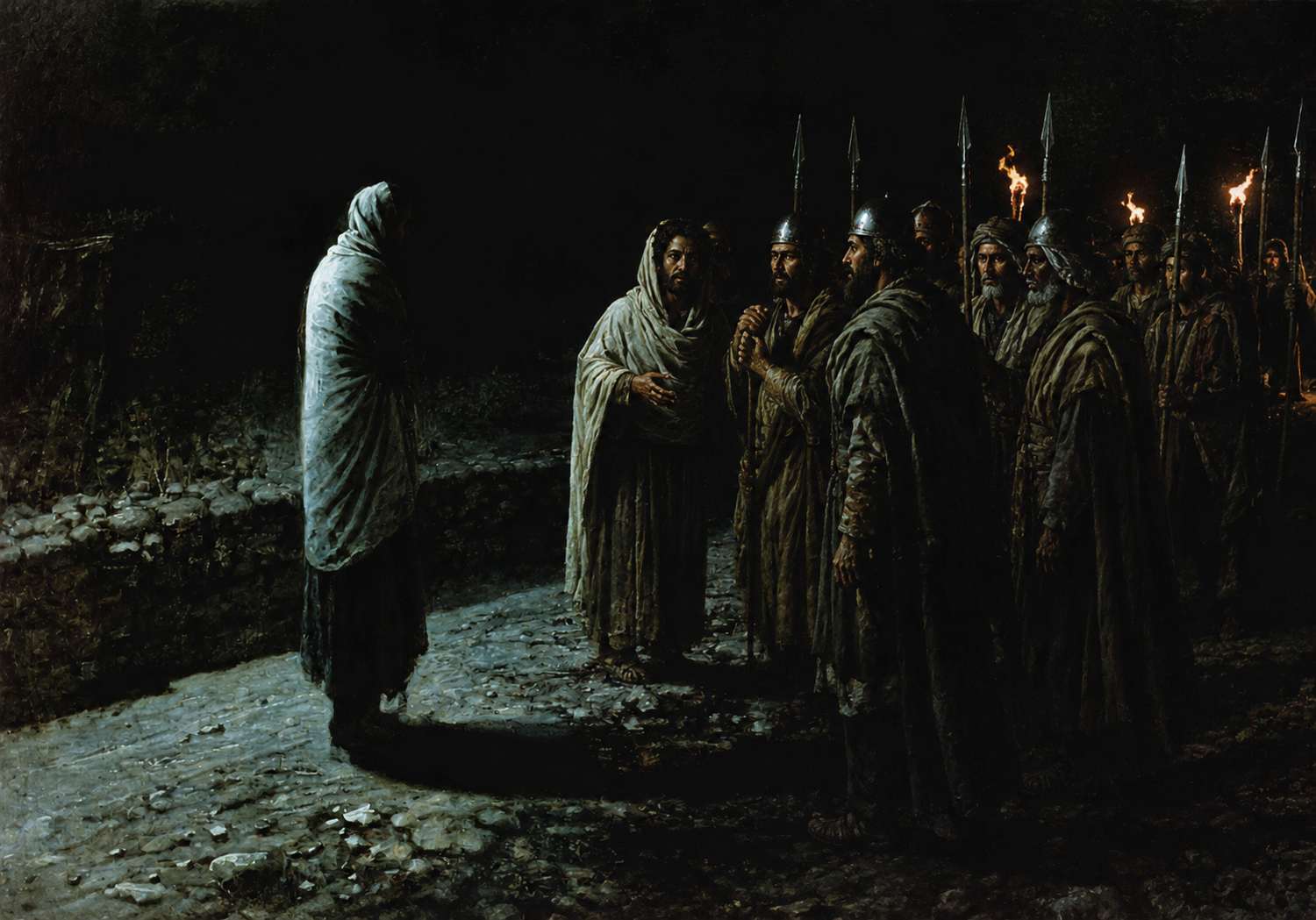
Every gospel account of the arrest uses the same Greek verb for what Judas does: paradidōmi, “to hand over,” “to deliver,” “to transfer custody from one party to another.” Matthew, Mark, Luke, and John all use it for Judas’s approach to the chief priests and for the arrest in the garden, and the same verb recurs through the narrative for every subsequent transfer of custody, as Jesus passes from one authority to the next on the way to Golgotha. The word carries no built-in charge of treachery in Greek; it is the ordinary term for handing a prisoner to Roman custody, or for a teacher transmitting tradition to a student, or, in Paul’s letters, for handing on the gospel itself. Whatever moral weight “betrayal” carries in English translations of this word, that weight comes from the interpretive tradition around the word, not from the word itself.
Is-kar and paradidōmi, across the distance between a Semitic name and a Greek verb, across several centuries, point at the same act. The name encodes the function; the verb describes it. If I am right about the etymology, the tradition preserved, in the very name it gave its villain, an accurate description of what the villain was going to do, and then built a moral verdict on top of a functional title without noticing the title was already there.
Rereading the Thirty Pieces
If Is-kar names the man of the covenantal transfer, the thirty pieces of silver look different. Scholars have long found the sum strange as a bribe: thirty shekels is the compensation set in Exodus 21:32 for a slave killed by a goring ox, and it is the wage Zechariah receives for his shepherding work in Zechariah 11:12. As payment for information leading to an arrest, thirty pieces is a low sum, and the tradition has never given a satisfying account of why the chief priests would offer it or why Judas would take it.
Against the eshkar background, the thirty pieces stop looking like a bribe and start looking like tribute, the structured payment rendered when a covenantal obligation is fulfilled. The kings of Tarshish bring eshkar to the enthroned king in the Psalm, and the nations bring it to Tyre in Ezekiel; on this reading, Is-kar brings his thirty pieces to the chief priests at the moment the transfer his name encodes is completed. Matthew’s typological link to Zechariah then reads as more than decoration: it is the tradition layering scripture onto a function the name had already assigned, giving the tribute payment a sacred frame while the name itself kept, in its consonants, the covenantal structure the payment fulfilled.
The weight this carries needs stating without inflation: the etymology, if correct, makes the connection to eshkar plausible; it does not make the thirty pieces provably a technical tribute payment rather than a narrative device drawing on Zechariah. Both readings can be true of the same text at once.
Philo’s Karabbas
One further piece of the picture comes from a source outside the gospel tradition entirely. Philo of Alexandria, in Against Flaccus, written around 40 CE, two or three decades before any gospel, describes a crowd during anti-Jewish rioting in Alexandria seizing a man of diminished mental capacity named Karabbas. They dress him in mock royal robes, set a reed in his hand for a scepter, crown him with rushes, and hail him as Marin, “lord,” in mockery of Jewish claims to kingship. The parallels to the gospel mockery scenes (purple robe, improvised crown, reed scepter, mock homage) are close, too close for coincidence to be an adequate explanation, and Philo is writing independently of Mark or Matthew, recording a local Alexandrian memory that has nothing to do with the Passion narrative on its face.
The name Karabbas shares consonants with Barabbas, “son of the father,” and I think both names deserve to be set beside Is-kar, since all three orbit the same root territory even if the derivations are not identical. This connection is the least secure part of the argument, and I hold it more loosely than the eshkar reading: three names, in three different sources, sharing a consonantal neighborhood does not by itself establish a single historical event behind all of them. What it does suggest, if the pattern is real, is that the Passion narrative’s central names function as descriptions of role rather than as biographical detail, which is the same conclusion the Is-kar etymology reaches by a different route.
What the Tradition Did With the Name
If Is-kar is a functional name rather than a geographic or factional one, something has to explain why the tradition read it otherwise for two thousand years. Consonants alone do not fix a word’s sense; a reading community’s choice of vowels does, and a tradition that needed Judas to be a betrayer rather than a covenantal functionary had every reason to vowel the name toward a place or a faction rather than toward a payment. The consonants could not be removed, because the name was too embedded in the narrative to drop, so they stayed while the vowels were pointed elsewhere, and the redirection succeeded so completely that it took an Aramaic philologist working on an unrelated set of Syrian inscriptions, publishing in a specialist journal in 1958, to put the pieces within reach of each other. Fitzmyer was not solving the Iscariot problem. He was doing careful work on the Sefire treaties, and it is only in hindsight, reading the Passion narrative back through his findings, that the connection becomes available at all.
The case carries real weight without settling the question. The eshkar derivation of ish-kar rests on a rare word attested twice, in a context that fits the covenantal reading well; the Sefire parallel gives that covenantal sense textual footing outside the Bible; the Greek paradidōmi tracks the same function across languages; and the Karabbas material, weaker than the rest, suggests the pattern may run wider than one name. None of this proves that a historical Judas literally functioned as a treaty official or that his contemporaries heard “man of tribute” when they used his name. What it establishes is that the name can be read as a function rather than an origin, that the reading has textual support the geographic and factional proposals lack, and that the tradition’s villain may carry, in his name, the one accurate description it kept intact.
This essay supplements Chapter Seven of The Twelve Who Were Not: Composite Apostles and the Making of Early Christianity by Ronnel D. Chua, available on Amazon. The trilogy Unmerging Christian Origins also includes The Gospel as Mirror (Volume One) and The Two Pauls (Volume Two).
Leave a Reply