
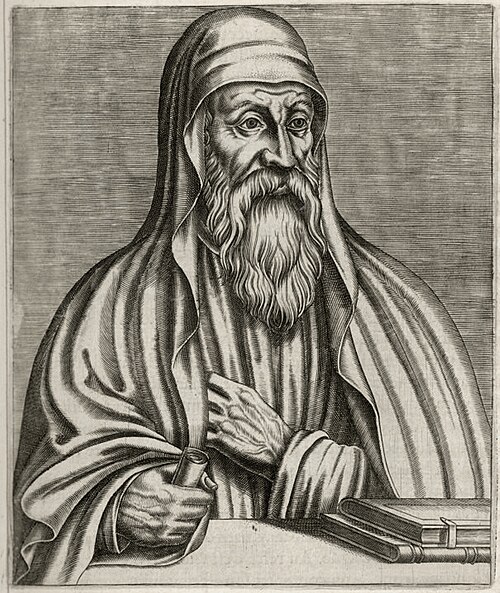
Origen of Alexandria was not a man easily frightened by difficult texts.
He had spent his life inside them. Born around 184 CE in Alexandria to a Christian family (his father Leonidas died as a martyr under the Septimius Severus persecution in 202 CE, an event that shaped everything about how Origen understood what serious faith cost), he became the most intellectually formidable biblical scholar of the early church and arguably the most prolific writer in Christian antiquity. Jerome, writing two centuries later, counted two thousand works attributed to him, a number probably exaggerated but indicative of a truly extraordinary output. He ran the catechetical school in Alexandria, trained students who became bishops across the eastern Mediterranean, corresponded with emperors, debated philosophers, and produced the Hexapla, a six-column parallel edition of the Old Testament in Hebrew and multiple Greek translations that remains one of the most ambitious scholarly projects in the history of biblical study.
He also castrated himself in a literal reading of Matthew 19:12, “there are eunuchs who have made themselves eunuchs for the sake of the kingdom of heaven,” an act he apparently came to regret and that his later critics used against him with considerable enthusiasm. He was eventually condemned as a heretic after his death, his works declared anathema by the Second Council of Constantinople in 553 CE, which meant that much of what he wrote survived only in fragments, in translations, and in the works of those who quoted him in order to refute him. The man who had spent his life inside difficult texts became a difficult text himself, preserved in pieces, controversial in his conclusions, orthodox and influential on one side of the ledger, heterodox and eventually condemned on the other.
This was not a man who flinched at textual problems. He had stared into harder ones than most and written his way through them with a combination of intellectual courage and theological conviction that his admirers have never stopped finding remarkable. So when Origen found something in Matthew’s Gospel that made him flinch, something that produced in him a discomfort visible to the point that he felt compelled to address it in his commentary, and to suggest, carefully, obliquely, but unmistakably, that later scribes had probably done the right thing by removing it, the discomfort deserves the same seriousness Origen’s reactions to textual evidence generally deserve.
The something was a name, the name Jesus attached to Barabbas in the earliest manuscripts of Matthew 27:16-17.
The Manuscript Evidence
The text of Matthew 27:16-17 in the earliest and most reliable manuscripts reads as follows. Pilate addresses the crowd: “Whom do you want me to release for you: Jesus Barabbas, or Jesus who is called Christ?” And again in verse 17: “Whom do you want me to release for you: Jesus Barabbas, or Jesus who is called Christ?”
Two men shared the name Jesus. One was designated Barabbas, Bar-Abba, Son of the Father in Aramaic. The other was designated Christ. The crowd had to choose between them.
The textual evidence for this reading is substantial. The Caesarean text-type manuscripts, a significant family of New Testament manuscripts associated with the scholarly tradition of Caesarea Maritima where Origen himself eventually worked, preserve the full name Jesus Barabbas. The Armenian manuscript tradition preserves it. The Georgian manuscript tradition preserves it. Several important Greek witnesses preserve it. Bruce Metzger, in A Textual Commentary on the Greek New Testament, the standard reference work for New Testament textual criticism published by the United Bible Societies, acknowledges the manuscript evidence directly and treats the reading as probably original, citing the principle of lectio difficilior: the harder reading is generally original because scribes simplify rather than complicate, and “Jesus Barabbas” is the harder reading by any measure. A scribe faced with “Jesus who is called Christ” would have no reason to add the name Jesus to Barabbas. A scribe faced with “Jesus Barabbas” would have every reason, theological and emotional, to remove the name.
The later manuscript tradition, which forms the basis of most medieval copies and therefore of most popular awareness of the text, contains only “Barabbas.” The name Jesus has been systematically removed, leaving what appears to be a complete personal name rather than the truncated royal designation that Bar-Abba actually is.
The removal was not accidental. It was the consequence of a decision made by scribes working in a theological tradition shaped, at least in part, by Origen’s discomfort.
What Origen Actually Said
Origen’s commentary on Matthew, written during his years in Caesarea after his departure from Alexandria around 231 CE, addresses the Barabbas passage in what has survived as Fragment 121 of his Matthew commentary. The surviving text, preserved in Latin translation since the Greek original of this section is lost, is a passage I want to examine with care, because the combination of acknowledged evidence and theological anxiety it displays is precisely the kind of textual moment this book has been arguing repays close attention.
Origen notes that in many manuscripts known to him the name Jesus appears before Barabbas, giving the full reading “Jesus Barabbas.” He acknowledges this. He does not pretend the reading does not exist or claim it represents scribal error in any simple sense. But then he does something revealing: he suggests that no sinner should share the name of Jesus, that the name belongs to the Savior alone, and that the manuscripts lacking the name Jesus before Barabbas are therefore probably to be preferred, not because they are textually superior but because the theological implication of the fuller reading is unacceptable.
The argument is circular in a way that Origen, one of the most logically rigorous minds in early Christian scholarship, would under ordinary circumstances have recognized and rejected. One does not decide which manuscripts are correct by choosing the reading whose theological implications one finds acceptable. One decides which manuscripts are correct by examining the manuscript tradition, the scribal patterns, the principles of textual transmission, and the internal evidence of the text itself. Origen knew this. He had spent his career doing exactly this kind of work on the Old Testament in the Hexapla. I take his willingness to abandon text-critical principle at this point, to prefer a less well-attested reading purely on theological grounds, as the measure of how much this particular name disturbed him.
It disturbed him because two men named Jesus standing before the crowd at Pilate’s tribunal was not a comfortable image for a theologian working to establish the unique and saving significance of the name of Jesus Christ. If Barabbas shared the name, then the crowd was not choosing between good and evil in any simple sense. They were choosing between two Jesuses, two men bearing the same name, and the choice was not between the named and the unnamed but between one bearer of the name and another. The theological architecture of the scene, which the tradition needed to be a demonstration of human wickedness choosing a criminal over the innocent Son of God, was complicated almost to the point of dissolution by the discovery that the criminal and the Son of God carried the same name.
Origen’s solution was to suggest that the manuscripts preserving the fuller reading had probably been corrupted by heretics, a standard polemical move in patristic textual argument, and that the manuscripts without Jesus before Barabbas were to be preferred. He said it carefully, he said it tentatively, but he said it, and what he said became the basis for the scribal practice that systematically removed the name from subsequent copies of Matthew.
The Tradition That Followed
Origen’s influence on subsequent Christian scholarship was so pervasive that tracing the transmission of his discomfort about the Barabbas name through the manuscript tradition is less a matter of documentary evidence than of inference from the pattern of the manuscripts themselves. The pattern, even so, is clear. Before Origen’s commentary circulated, manuscripts with “Jesus Barabbas” existed and apparently drew no particular comment. After Origen’s commentary circulated and his theological objection to the fuller reading became part of the scholarly tradition, scribes copying Matthew systematically removed the name.
Jerome, the great translator whose Latin Vulgate became the standard biblical text of Western Christianity for over a millennium, knew Origen’s work intimately. He was simultaneously Origen’s greatest admirer and, after his break with Origenist theology in the 390s CE, one of his sharpest critics. Jerome translated and adapted many of Origen’s homilies, knew his Matthew commentary, and produced the Vulgate’s Matthew text in the late fourth century. The Vulgate reads simply “Barabbas,” with no Jesus before the name, and the Vulgate’s authority over Western Christianity for a thousand years meant that the name Jesus Barabbas became invisible to the vast majority of Christian readers and scholars through the medieval period.
The Eastern tradition maintained more diversity. The Caesarean manuscripts, the Armenian tradition, and the Georgian tradition preserved the fuller reading, which is why modern critical editions of the Greek New Testament, specifically the Nestle-Aland twenty-eighth edition that forms the basis of modern scholarly work on the Greek text, include the reading “Jesus Barabbas” in their critical notes and mark it as probably original. The United Bible Societies Greek New Testament, fifth edition, gives the reading a “B” rating in Metzger’s textual commentary, meaning the text is almost certain, while acknowledging the difficulty the theological tradition created for its preservation.
What the critical tradition has established, working from the evidence rather than from theological preference, is that the manuscripts Origen found troubling preserved the original text, and the manuscripts he preferred had already been altered by the time he encountered them or were altered subsequently on the basis of his recommendation. The name was always there. Origen’s discomfort removed it, and the removal was so thorough that only the manuscript tradition’s survival in diverse geographical locations, Caesarea, Armenia, Georgia, Egypt, preserved sufficient witnesses to the original reading for modern textual criticism to recover it.
Why the Name Mattered: What Origen Was Protecting
Origen’s discomfort was not irrational. It was the response of a theologian who understood the implications of the fuller reading better than most of his contemporaries, even if his response to those implications was to suppress the evidence rather than follow it.
If Barabbas shared the name Jesus, the scene at Pilate’s tribunal was not the scene the tradition needed it to be. The tradition needed it to be the definitive demonstration of human sinfulness, the crowd given a clear choice between good and evil, choosing evil, demanding the death of the innocent one and the release of the guilty one. The theological weight of that scene, in the tradition’s reading, depended on the contrast being absolute: one man innocent, one man guilty; one man divine, one man criminal; one name holy, one name stained.
Two men named Jesus complicated every element of that contrast. If both men carried the same name, the choice was not between the named and the unnamed, the holy and the profane, the innocent and the guilty. It was between two bearers of the same name, which raised the question of why they shared it, what the sharing meant, and whether the crowd’s choice between them was the simple moral failure the tradition required it to be.
Origen was protecting the theological architecture of the Passion narrative, against a textual detail that, on his reading, threatened to dissolve the architecture’s moral clarity. His discomfort was the discomfort of a man who understood that the name “Jesus Barabbas” carried implications he could not follow to their conclusions within the theological framework he was committed to defending.
I want to follow those implications to the conclusions Origen could not reach. Jesus Barabbas, Bar-Abba, Son of the Father, was not a criminal who happened to share the Savior’s name by unfortunate coincidence. He was, on the reconstruction this book has been building, the royal designation of a Herodian prince whose father’s dynasty had been appointed kings of the Jews by Roman senatorial decree, whose birth the Gospel of Matthew encoded in the inverted form of the nativity narrative, whose public career the Synoptic Gospels preserved as the Radical’s biography without understanding whose biography it was, and whose assumption of the Teacher’s pequddah in Gethsemane produced the substitution that the empty tomb, the folded face cloth, and the recognition failures of the resurrection appearances all encode in different ways.
The crowd shouting his name at Pilate’s tribunal was not, on this reading, choosing evil over good. They were invoking the royal designation of their prince, Bar-Abba, Son of the King, trying to save the man they had acclaimed at the triumphal entry by using the name that named his actual identity, maneuvered through the mechanics of the substitution into condemning the man they were trying to free, because the man they were trying to free was standing before them under a different name, the Teacher’s name, the identity assumed in Gethsemane.
Origen sensed, correctly, that preserving the name “Jesus Barabbas” in Matthew’s text would make it harder to maintain the moral clarity the tradition needed the Barabbas scene to carry. He was right about that much. What he did not know, and what two thousand years of manuscript tradition built on his discomfort prevented anyone from fully investigating, was that the name’s implications ran not toward moral murkiness but toward historical particularity, toward the actual identity of the man whose release the crowd was demanding, whose royal title was encoded in the name Barabbas, and whose story the Gospel tradition had been encoding, suppressing, and accidentally preserving since the first generation of the Christian movement.
The Name and the Irony
The irony of Origen’s intervention deserves to be named directly.
Origen was one of the most committed advocates in the early church for reading scripture at multiple levels simultaneously, the literal, the moral, and the allegorical. His On First Principles, the systematic theological treatise that later contributed to his condemnation, is built on the argument that scripture carries layers of meaning literal reading alone cannot reach, that the surface of the text often conceals deeper truths that allegorical interpretation uncovers, and that the apparent difficulties and contradictions in scripture are not failures of the text but invitations to deeper reading. He spent his life arguing that the hard readings, the troubling passages, the texts that resist surface interpretation, were precisely the ones that contained the most important truths.
And then he encountered “Jesus Barabbas” and recommended removing it.
The consistency between his general hermeneutical principles and his response to this particular text is, to put it charitably, imperfect. His own principles would have required him to dwell with the difficulty of the shared name, to ask what the difficulty was protecting, to investigate rather than suppress. Followed consistently, those principles would have led him toward exactly the kind of investigation this book undertakes: an inquiry into what historical reality the surface narrative of the Barabbas scene was encoding in inverted form, what the shared name revealed about the actual identities of the two men standing before Pilate, and why the crowd’s response to both names produced a scene the tradition needed to read as a moral failure and that the evidence suggests was something considerably more particular.
Instead, he recommended removing the harder reading. He used his theological authority to support the easier reading, the one that preserved the moral clarity the tradition required, the one that made the scene legible as the simple choice between good and evil the Passion narrative’s theological architecture needed it to be.
The scribes followed his recommendation. The name disappeared from the majority of manuscripts. The easier reading became the standard text. And the harder reading survived only in the margins of the tradition, in the Caesarean manuscripts associated with the scholarly community Origen himself eventually led, in the Armenian and Georgian traditions that maintained their own textual independence, in the fragments and traces that modern textual criticism has reassembled into the reconstruction the evidence has supported all along.
Origen’s discomfort was the discomfort of a man who was very nearly the right reader for the right text. He had the hermeneutical principles. He had the scholarly training. He had the intelligence and the textual knowledge and the willingness to dwell inside difficult passages. What he lacked was the historical framework that would have let him understand why the name “Jesus Barabbas” was not a theological problem requiring a textual solution but a historical signal requiring a historical investigation.
The signal has been waiting in the manuscript tradition for seventeen centuries, preserved in the very manuscripts associated with the scholarly community Origen founded, surviving his recommendation to remove it in a sufficient number of witnesses to allow modern textual criticism to recover it, pointing toward the historical reality Origen’s theological commitments prevented him from following and that this book attempts to follow in his place.
Jesus Barabbas. This was Son of the Father, Son of the King, the name the crowd was shouting when they thought they were asking for the release of a criminal, and were actually invoking the royal designation of their prince, the man who had come in his father’s name and been rejected, the man who stood before Pilate under the Teacher’s identity while his royal title was simultaneously being demanded for his release by the crowd that loved him and condemned him without knowing it was doing both at once.
Origen was right to be uncomfortable. The name carried more than his theology could hold. It still does.
Leave a Reply