
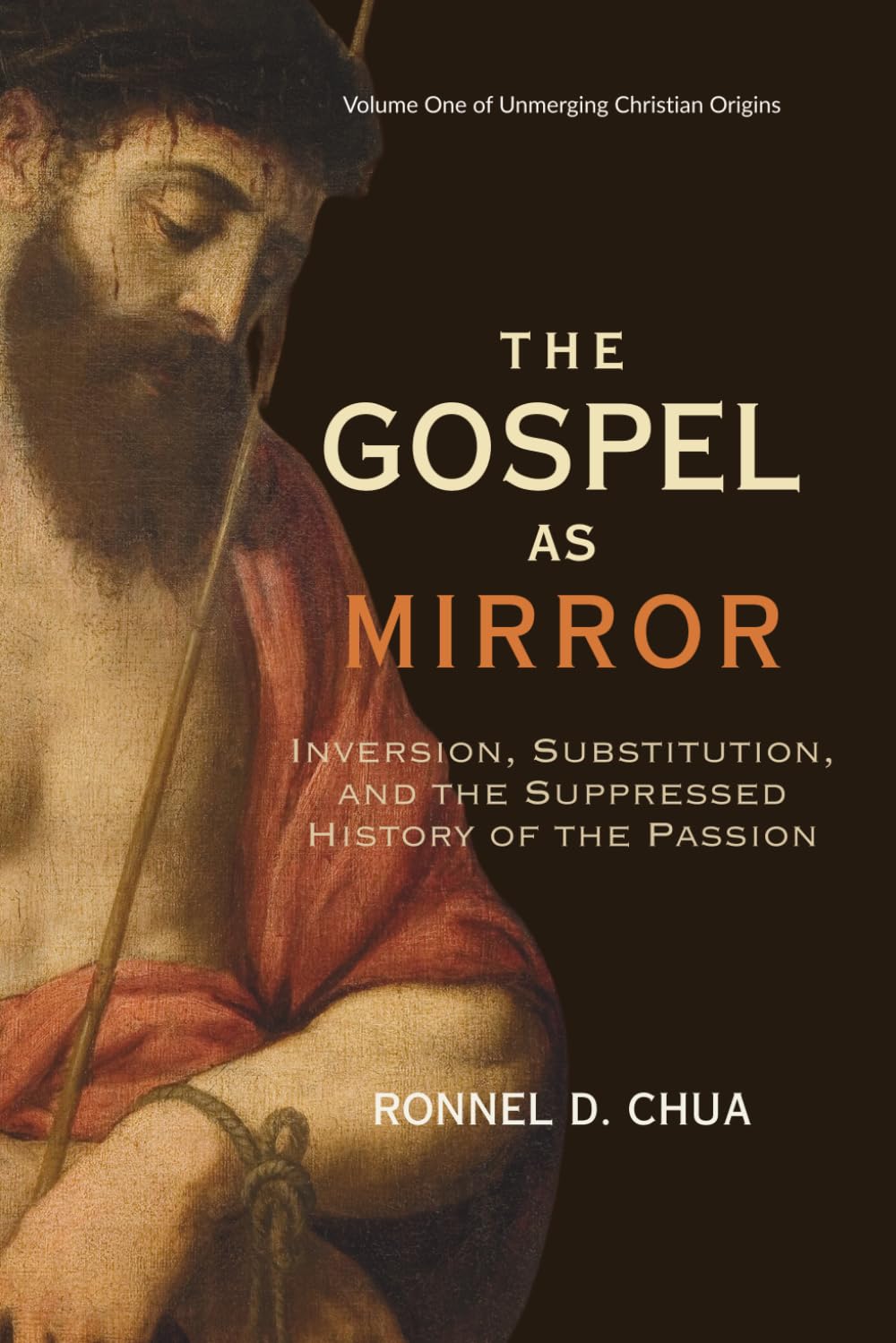

Two men named Jesus, both claiming messianic authority, both gathering followers, both destabilizing the established order, though in almost opposite registers. One worked in public, confrontationally, in the idiom of apocalyptic expectation, building a movement that Rome and the Temple establishment had reason to fear. The other worked more quietly, teaching a wisdom oriented toward internal transformation rather than political confrontation. I want to trace where these two trajectories meet, and argue that the meeting point is the Passion itself.
The Teacher needed a way to survive pressure from authorities who, I would argue, had little interest in sorting out which man named Jesus they were dealing with. The Radical, by contrast, had reached the point where confrontation made his death close to inevitable. My reconstruction holds that the substitution sealed at Gethsemane — the kiss functioning as an act of identification rather than mere betrayal — allowed the Teacher’s public identity to pass to the Radical. The Radical died under the title “Jesus of Nazareth, King of the Jews,” satisfying Rome’s need to eliminate a political threat. The Teacher withdrew, kept safe, as John 17:12 has it, in the Father’s name.
The claim that follows is this: the Church that took shape afterward needed both men, though it could never say so. It needed the Radical’s death to supply a sacrifice narrative capable of answering the appeal of a dying and rising savior. It needed the Teacher’s wisdom to supply the philosophical content that could draw educated Greeks and Romans into the movement. Merged into a single Christ, the two produced a figure able to be, more or less, whatever the moment required.
The merger, though, was never complete, and this is where the argument becomes testable rather than merely suggestive. The canonical Gospels preserve the seams because they draw on two different sets of sources, two memory streams rooted in two communities that had known two different men. Matthew, Mark, and Luke stay closer to the Radical’s tradition — apocalyptic, political, confrontational, ending in a death that is simply a death. John stays closer to the Teacher’s tradition — mystical, oriented toward eternity, withdrawn, treating spiritual reality as more consequential than physical death.
When the Church canonized four Gospels instead of choosing one, it canonized the contradiction along with them. The Gospels preserve two genealogies, two birth narratives, two relationships to the Temple, two Passover chronologies, and two eschatologies. They also preserve two understandings of Jesus himself, which were never quite reconciled. The assumption, over the centuries, was that theological interpretation could smooth over what were in fact historical differences between two men. For a long stretch of Christian history, that assumption held. Contradictions were relabeled mysteries. Incompatibilities became paradoxes, the kind of thing faith was supposed to hold rather than resolve. Different traditions leaned into different halves of the composite: some toward the apocalyptic figure, some toward the mystical one, some toward the political Jesus, some toward the otherworldly one. Denominational variety absorbed the plurality; different reading strategies gave each community a Jesus it could live with.
But the contradictions were never actually resolved, because interpretation cannot resolve what are, on inspection, competing factual claims. The birth narratives are separated by roughly a decade of historical time — Matthew’s Herod is dead before Luke’s census takes place. The two genealogies run through different sons of David and never converge. The Temple functions, in one telling, as the site of a single violent disruption that triggers arrest and execution, and in another as a routine teaching venue where the same man spends extended periods without incident. The Passover chronology places the Last Supper and the crucifixion on different days depending on which Gospel is read. The final words from the cross register either abandonment or completion, and no amount of theological framing makes both true of a single dying man in a single moment. Not interpretation problems. Historical ones. The texts are describing different events, and I don’t see a way around that conclusion once the details are placed side by side.
What survives underneath two thousand years of harmonizing effort is, I would argue, the residue of two distinct lives that the early Church needed to present as one. The Teacher lived to old age, carrying his teaching to Arabia and Asia Minor and becoming, on this reconstruction, the root of the mystical and Johannine tradition. The Radical died young on a Roman cross and became the root of the martyrdom and apocalyptic tradition. Between them they supplied everything the early Church needed to convert a failed Jewish messianic movement into a religion with the reach to outlast an empire. The complexity that Christian theology has spent centuries celebrating as evidence of divine paradox turns out, on this reading, to be something considerably more mundane: the difference between two men whose combination produced a figure that neither, on his own, could have been.
Leave a Reply