
One of the most persistent metaphors in the Hebrew Bible is the language of the way, the road, and the path. Human beings walk with God, follow God’s way, depart from it, return to it, or lose their way entirely. The righteous walk in one direction and the wicked in another. The prophets call Israel back to ancient paths. Wisdom gets described as a road, righteousness as a path, disobedience as turning aside from it.
So when the book of Acts repeatedly calls the early Jesus movement the Way, that expression should not be treated as an isolated Christian invention dropped out of nowhere. It belongs to an older Jewish vocabulary that had been building for centuries before Acts picked it up.
At the same time, historical criticism calls for caution here. One cannot simply draw a straight line from Genesis to Acts and assume every biblical author consciously intended the same symbolic system running underneath his words. These texts were written across different periods and contexts, and the Greek word translated way, hodos, does not always line up cleanly with the Hebrew derekh. Still, the way this language keeps recurring across Jewish scripture and early Christianity points toward a shared conceptual world, one in which human existence gets understood as a journey along a morally and religiously significant path. The tradition traces back further than one might expect.
The Way Out of Eden
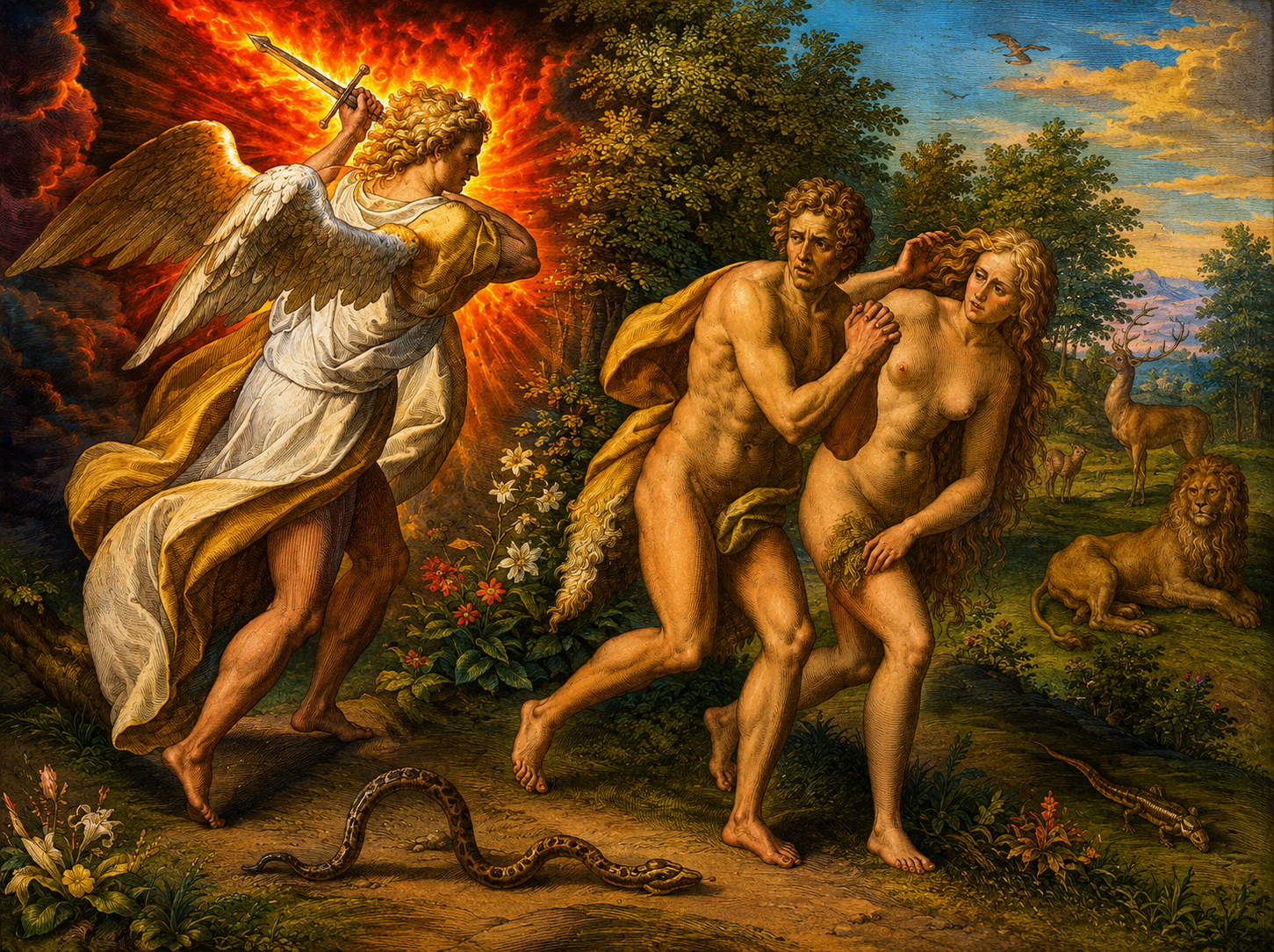
The connection to Eden needs an important qualification from the start. Genesis does not say in so many words that Eden is the starting point for some formal doctrine called the Way, and it does not describe Adam and Eve following a path in the same technical sense later biblical texts use. Yet Genesis 3:24 contains a phrase that deserves a pause: he placed the cherubim, and a flaming sword flashing back and forth, to guard the way to the tree of life. The Hebrew expression is derekh ‘ets haḥayyim, literally the way of the tree of life, or the path to the tree of life. The immediate context reads clearly on its own terms. Humanity has been expelled from the garden, and access to the tree of life now rests under guard.
The weight this verse carries for the later path tradition should not be overstated. Genesis itself never develops the metaphor into a running theology of the Way. What it does establish is a narrative pattern later Jewish literature keeps returning to: humanity cut off from God’s presence and from the source of life, with the question of how a person lives, returns, or approaches God standing at the center of everything that follows. The story begins, in other words, with a way that is inaccessible.
Everything afterward unfolds in a world outside Eden. People wander. Families migrate. Israel leaves Egypt and crosses the wilderness. The prophets keep calling the nation back. Throughout all of it, the language of movement becomes a way of talking about faithfulness itself. Eden is not necessarily the historical source behind every later use of way, but it gives the biblical imagination an important starting point, a picture of a people who have lost their original bearings and have to learn, generation after generation, how to walk again.
The Way of the LORD
The Hebrew Bible gradually stretches this language past physical roads. In Genesis 18:19, God speaks of Abraham and his descendants: I have chosen him, that he may command his children and his household after him to keep the way of the LORD by doing righteousness and justice. Here the way of the LORD ties directly to ethical conduct, and the Hebrew term derekh has clearly moved beyond geography by this point. It can describe an entire pattern of life. To keep the way means living in a manner consistent with what God demands, and this usage spreads widely across the rest of the tradition. The Psalms contrast the way of the righteous against the way of the wicked. Proverbs describes wisdom as a path and warns against crooked ways. Deuteronomy speaks repeatedly of walking in God’s ways, and the prophetic literature uses the same vocabulary to describe Israel’s faithfulness or its apostasy.
The metaphor is deceptively simple once its logic is noticed: nobody merely possesses a way. A way gets walked. This is part of why the biblical language of walking carries so much weight. The Hebrew verb halakh, to walk or to go, becomes tied to conduct and behavior generally. To walk before God is to live before God. To walk in God’s ways is to order one’s whole life by divine instruction.
This linguistic background eventually matters for later Jewish discussions of religious practice too. The Hebrew noun halakhah, which would go on to become a central term in rabbinic Judaism, is itself related to the root halakh. The later technical meaning of halakhah belongs to rabbinic Judaism and should not get projected back into the biblical period, but the underlying metaphor still tells us something real: religion, in this vocabulary, is something walked. It is a direction taken through a life, not a possession held still.
The Two Ways
By the time the wisdom literature is reached, the metaphor has become a major framework for moral instruction outright. Psalm 1 presents two contrasting ways, the righteous person avoiding the counsel of the wicked while the wicked ultimately come to ruin. Proverbs keeps contrasting the path of wisdom against the path of folly. The image running through all of this is not merely geographical. It works as a moral map, one carrying real choices and real consequences, where a person’s life gets understood as movement toward some final end.
This two ways pattern becomes especially visible in later Jewish literature. The Didache, an early Christian text probably dating from the late first or early second century, opens with a discussion of two ways, one of life and one of death. The Didache is a Christian text considerably later than the Hebrew Bible, but its structure shows how persistent this moral-path tradition remained inside early Christianity. The idea itself runs older than Christianity and wider than Christianity, and the early Christians inherited it along with everything else.
Jeremiah and the Ancient Paths
Jeremiah 6:16 gives one of the clearest expressions of this whole tradition: stand at the crossroads, and look, and ask for the ancient paths, where the good way is, and walk in it. The image carries real force. The people are standing at a crossroads, forced to stop, forced to look, forced to ask, and only then to walk. The Hebrew word running underneath is derekh again, and the good way here works as something entered and followed with one’s feet, not merely an intellectual proposition to accept.
Jeremiah’s language also brings in another important theme: return. The people have lost their direction and have to seek out the ancient path again, and this is not simple nostalgia for an old road. The prophet is calling Israel back to covenantal faithfulness, which turns the path metaphor into a language of repentance. To repent, in this vocabulary, is effectively to change direction.
Isaiah and the Straight Way
The tradition takes another significant turn in Isaiah 40:3: prepare the way of the LORD in the wilderness, make straight in the desert a highway for our God. The Hebrew text uses derekh for way and speaks of making a highway straight. The setting here is the opening of Isaiah’s great consolation section, where the prophet announces the end of exile and Israel’s coming restoration. The image is a royal procession. A road has to be prepared. The wilderness has to be crossed. Obstacles have to be cleared, and the way itself has to be made straight before the procession can travel it.
The passage does not originally refer to John the Baptist at all. In its own historical context, Isaiah 40 speaks to Israel’s restoration and return from exile, and the way here connects to God’s own coming and to God’s people returning home. The later Gospel writers reread the text through John the Baptist instead, which matters for anyone reading this historically and critically, since Isaiah 40:3’s meaning in its original prophetic context and its meaning inside the Gospels are not identical. The Gospels reinterpret Isaiah for their own purposes. Mark 1:3, followed by Matthew and Luke, identifies John as the voice crying in the wilderness, prepare the way of the Lord, and Luke goes on with the imagery of valleys, mountains, crooked roads, and rough places all being made straight.
John the Baptist ends up standing at the intersection of two traditions at once, belonging to the prophetic world of Israel while also preparing the narrative entrance of Jesus. The language of the way has, by this point, become part of the Jesus movement’s own story.
John the Baptist and the Wilderness
The wilderness carries real weight of its own in this whole tradition. In the biblical imagination, it works as far more than empty landscape, the place where Israel got tested, where Israel learned dependence on God, where prophetic renewal could always begin fresh. John returns to that same wilderness with a message of repentance, telling the people they need to change direction, that the way has to be prepared, that the crooked ground has to become straight. This is exactly the kind of language in which the older Jewish path tradition could get reactivated inside a new historical moment.
John never says in so many words that people are joining some organization called the Way. The Gospel texts do not frame it in those terms. But they place his preaching squarely inside the older prophetic vocabulary of preparing God’s way, which sets up everything that follows.
The Way in Acts
It is in Acts that the expression takes on its most distinctive character. The followers of Jesus get repeatedly associated with the Way, hē hodos. Saul receives authority to arrest anyone belonging to the Way in Damascus (Acts 9:2). Later, Paul says he persecuted this Way to the death (Acts 22:4). In Acts 24:14, Paul tells the Roman governor Felix, I admit that I worship the God of our ancestors according to the Way, and the expression turns up several more times across Acts, including 19:9, 19:23, and 24:22.
This matters historically because it suggests the Way functioned as a recognizable designation for the Jesus movement inside the narrative world Acts constructs. But an important distinction needs making here. The undisputed Pauline letters, our earliest surviving Christian writings, do not commonly use the Way as a formal name for the movement at all. Paul instead speaks of those who are in Christ, of the churches of God, of believers, saints, brothers and sisters, and he uses extensive language about walking, particularly inside ethical arguments. That difference raises a real historical question. Was the Way an early designation Jesus-followers actually used themselves, later preserved by Acts, or is the expression mostly part of Luke’s own literary vocabulary? The evidence does not let anyone answer that with certainty. What the repeated use of the term across Acts does strongly suggest is that its author understood the movement through the language of the Way, and that this terminology carried real meaning inside his own Jewish-Christian conceptual world.
The Way as Hidden Knowledge
At this point, the words attributed to Jesus about the Way start to matter more directly. In the Gospel of John, Jesus declares, I am the way, and the truth, and the life (John 14:6). Read historically and critically, this saying belongs to the distinctive theological world of the Johannine Gospel and should not automatically be treated as a verbatim historical saying from the Jesus of Galilee, since John’s Gospel was composed later than the Synoptic tradition and presents Jesus inside a considerably more developed theological framework. Still, the statement matters for understanding how the early Christian tradition came to interpret the older path metaphor.
If Jesus is the Way, the expression can be read in at least two senses that work together rather than against each other. Jesus is the path to God, and Jesus is also the one who reveals how that path is meant to be walked. This second sense connects the Johannine saying with material found across the Synoptic Gospels, where Jesus says, enter through the narrow gate, for wide is the gate and broad is the road that leads to destruction, but small is the gate and narrow the road that leads to life, and only a few find it. Here Jesus speaks directly about the road leading to life, and the image recalls the older Jewish tradition of two ways, life on one side and destruction on the other, resonating too with the wisdom tradition’s insistence that human beings have to choose between paths.
But Jesus does something more than simply restate that older choice. He teaches people how to actually recognize the path, warning that the obvious road is not necessarily the right one, that the broad road is easy while the narrow road is difficult, and that the majority may travel one way while the truth rests somewhere else entirely. That gives real depth to the claim I am the Way. It does not have to be reduced to the idea that Jesus is merely a destination people travel toward after death. Inside the larger tradition, he can be understood as the revealer of the path, the teacher who knows the way to life and teaches others how to walk it themselves.
This reading also helps explain the intense conflict between Jesus and the religious authorities running through the Synoptic tradition. In Luke 11:52, Jesus tells the lawyers, woe to you lawyers, for you have taken away the key of knowledge, you did not enter yourselves, and you hindered those who were entering. The imagery here carries real force. There is knowledge. There is a key. There are people trying to enter, and there are others who have placed themselves between the seeker and the entrance. The passage never uses the actual word way, but it belongs squarely inside the same conceptual world of access and entry running through this whole tradition. The problem Jesus names is not merely that the authorities failed to enter themselves. They also hindered those who were entering, which, read against the path tradition, works as a real critique of religious gatekeeping. The way to God has become obstructed. The people claiming to hold the keys have failed to enter through them, and instead of opening the path for others, they have made it harder to reach.
This connects to another major theme running through Jesus’s teaching, the gap between knowing the path and actually walking it. The religious expert may know the law, know the traditions, hold the texts in his hands, but knowledge without walking becomes its own kind of contradiction, and that is exactly the tension running through the biblical path tradition from the start. The question was never simply whether someone possesses the map. It is whether they actually walk the road.
The Secret and the Hidden Path
Another saying of Jesus may deepen this reading further. In Matthew 6:6, Jesus tells his disciples, when you pray, go into your room and shut the door and pray to your Father who is in secret. This belongs to Jesus’s teaching on hidden righteousness, moving prayer out of public display and into a private place. The Greek term tameion refers to an inner room or private chamber, and historically this saying is not about the Way in any direct sense. But set inside the broader pattern of Jesus’s teaching, it reinforces a real distinction between external religion and inward transformation. The path to God is not necessarily found in public religious performance. The kingdom is not entered through status. Truth is not controlled by religious authorities. The encounter with God takes place instead in the hidden place, the inner room, the secret, the heart.
This is why the language of the Way should not get reduced to a physical road, or even simply to membership in a religious institution. The path reads as an existential and spiritual movement. It has to be entered, walked, turned toward inwardly, sought and discerned rather than merely inherited. The key cannot simply be handed over as institutional property. It has to be discovered and lived out.
Jesus as the Keeper and Revealer of the Path
Put all of this together and a possible synthesis emerges. If the ancient Jewish tradition speaks of a way of God, if Jeremiah calls people back to the ancient paths, if Isaiah announces that the way of the LORD must be made straight, then the Jesus tradition presents Jesus as the one who knows the way and teaches it directly. The statement I am the Way can be understood not merely as a claim about destination but as a claim about revelation. Jesus possesses knowledge of the path. He reveals it, teaches it, embodies it, and, in John’s theological language, becomes the path itself.
This reading also illuminates the accusation against the lawyers in Luke 11:52. If the path leads to life and to knowledge of God, then taking away the key of knowledge means obstructing access to that path directly. Jesus’s criticism here works as a struggle over who controls access to God and who holds the authority to define the road leading there, rather than a simple argument over ritual or legal interpretation. The religious authorities claim to hold the keys, and Jesus accuses them of using those keys in a way that keeps them from entering themselves while blocking everyone else too. The whole conflict comes down to access: who controls the gate, who actually knows the road, who decides who gets to enter, and what happens once the people claiming to guard the path become the very people standing in its way.
The Road to Damascus
Paul’s story takes on a richer meaning once set against all of this. Paul begins as an opponent of the Way, traveling toward Damascus to arrest anyone belonging to it. According to Acts, he is not converted inside a church, a synagogue, or a theological classroom. He encounters Christ on the road itself, which is one of the great narrative ironies running through Acts: the man traveling to destroy the Way encounters the risen Jesus while traveling himself. The persecutor is stopped mid-journey. He loses his sight and has to be led by others, and only later does his sight return.
Historically, Paul’s own letters give the earliest evidence for his experience of revelation. In Galatians 1:15-16, he says God revealed his Son to him. In 1 Corinthians 15:8, he describes himself as one who saw the risen Christ. Paul’s letters never narrate the Damascus road in the detailed form Acts gives it, and the three separate accounts in Acts differ from each other in their own details and emphasis, which means the Damascus road story, read historically and critically, has to be distinguished from Paul’s earliest personal testimony about the same event. Even so, the narrative structure Acts builds stays clear on its own terms. Paul’s encounter happens in the middle of a journey. He is heading in one direction when the encounter reverses his course entirely, and the road itself becomes the place of redirection, the persecutor turning into the movement’s most important advocate. Whether or not Luke intended every symbolic connection a reader might notice today, the narrative on its own creates a powerful image of conversion as a literal change of direction.
Walking Straight in Galatians
This connection gets more interesting once Paul’s letter to the Galatians is brought in. In Galatians 2:14, Paul confronts Peter in Antioch over the question of table fellowship between Jewish and Gentile believers, accusing Peter and the others of failing to act consistently with the truth of the gospel. The Greek expression here is unusual: ouk orthopodousin pros tēn alētheian tou euangeliou. The verb orthopodeō carries the sense of walking or proceeding correctly, literally having one’s feet moving in a straight line, and Paul’s accusation reads roughly as they were not walking straight according to the truth of the gospel.[1]
This is not the same Greek word as hodos, way, and it would be a real overreach to claim Paul is directly quoting Isaiah 40 or Jeremiah 6 here. There is no direct quotation running underneath it. But the metaphor still belongs to the same shared Jewish and biblical conceptual field. Paul’s point is that Peter’s conduct has become inconsistent with the gospel itself, that Peter is not walking correctly, and that the gospel creates a path of behavior demanding the practical direction of the whole community rather than abstract theology alone, since truth has to be embodied rather than simply affirmed in words.
Qumran and the Question of “The Way”
Any serious historical look at this subject has to take in the Dead Sea Scrolls too. The sectarian writings from Qumran repeatedly use the language of way, path, and walking, with the community understanding itself as living according to a divinely revealed order set against the ways of the wicked. The Community Rule speaks repeatedly about walking in perfection, walking in the way of darkness or light, and following the community’s appointed ordinances. The Damascus Document uses the same language of the way throughout.
None of this proves the Jesus movement borrowed the expression the Way directly from Qumran. There is no evidence that Jesus, John the Baptist, Paul, or the author of Acts ever had direct contact with the Qumran community, and the chronological and geographical evidence available does not establish that kind of connection. What Qumran does show is something historically important on its own terms: the language of walking in a divinely prescribed way was thoroughly alive across Second Temple Judaism well before any of this reached the Jesus movement. That movement did not emerge into a religious world where the Way was some entirely novel concept invented from scratch. It emerged inside a Jewish environment already saturated with the language of paths, walking, righteousness, wisdom, and covenantal obedience, and the similarity here is best read as evidence of a shared Jewish conceptual world rather than proof of direct borrowing, unless direct dependence can actually be shown.
From the Guarded Way to the Narrow Way
Set these traditions side by side and a real pattern emerges. Genesis presents humanity outside Eden with the way to the tree of life standing under guard. The Torah speaks of walking in the way of the LORD. The wisdom tradition contrasts the way of righteousness against the way of wickedness. Jeremiah calls Israel to seek the ancient paths. Isaiah announces that the way of the LORD must be prepared, and John the Baptist takes up that same language to announce the preparation of that way in his own generation. Jesus speaks of a narrow road leading to life and accuses religious authorities of taking away the key of knowledge, hindering those trying to enter. Acts calls the Jesus movement the Way outright, and Paul, according to Acts, encounters Christ while traveling toward Damascus before later confronting Peter for failing to walk straight according to the truth of the gospel.
The metaphor has, by the end of this whole sweep, picked up a real density. The way can be guarded, lost, blocked, made straight, narrowed, found, and walked, all across the same body of literature. I read Jesus’s declaration, I am the Way, against the background of that Jewish path tradition as something closer to a reworking of the destination itself: the path being searched for is revealed in him, the knowledge needed to enter that path is found in what he teaches, and the life to be walked is embodied in how he lives. This reading is my own synthesis of the material rather than a claim the Gospel of John states in those terms; the text gives the declaration itself, and the historical layering behind it is the argument I am making. The way to God was never secured simply by holding religious authority, legal knowledge, or institutional power. The way has to be entered, and it has to be walked.
This also explains why Jesus’s conflict with the religious authorities stands so close to the center of the Gospel tradition. The dispute was never simply about whether certain rules were correct. It is about who controls access to God in the first place. The Pharisees, scribes, and lawyers get portrayed differently across the different Gospels and should not be flattened into one undifferentiated historical group, but the Gospel narratives keep presenting Jesus challenging interpretations that, in his view, load burdens onto people while missing the deeper purpose of God’s law underneath them. The accusation in Luke 11:52 states the conflict in the language of a locked door: the key was taken, entry was refused, and others were prevented from entering. Inside that framework, Jesus appears as the one restoring access rather than simply handing people another religious system to follow. He points toward the path itself instead.
The Path Within
The teaching on secret prayer in Matthew 6:6 adds one more dimension here. Jesus tells the disciple to enter the inner room, close the door, and pray to the Father who is in secret, an image running almost opposite to public religious performance. The way to God turns up in the hidden place rather than in the spectacle of religion, and the path itself turns inward here. The kingdom of God is not accessed merely through external authority. The individual has to encounter God in the secret place directly, and at this point the path tradition turns interior. The road stops being only the wilderness outside and becomes the wilderness within as well, the ancient journey from Eden to the promised land turning into a journey of the soul.
None of this means the historical Jesus necessarily taught a fully worked-out doctrine of an inner path in the later mystical sense that would go well beyond what the evidence actually supports. But the Gospel tradition does preserve a consistent emphasis on the hidden, the inward, and the unseen throughout. The Father sees in secret. The treasure stays hidden. The narrow gate is hard to find. The key of knowledge can be lost, and the path can be obscured by religious authorities who were supposed to be guarding it. The seeker has to learn, across all of this, to see differently than the crowd around them does.
The Ancient Tradition Reinterpreted
The historical development, read cautiously, might be summarized this way. The Hebrew Bible supplies the foundational vocabulary of derekh, the way, and halakh, walking. Israel gets called to walk in God’s ways. The wisdom tradition develops the contrast between competing paths. Jeremiah calls the people to seek the ancient paths, and Isaiah speaks of preparing the way of the LORD. Second Temple Jewish communities, Qumran included, keep using the language of walking in divinely revealed ways well into the era closest to Jesus. John the Baptist reactivates the prophetic language of the wilderness and the straight way, and the Jesus tradition presents a narrow road leading to life, with Jesus criticizing religious authorities who, in Luke’s account, have taken away the key of knowledge and hindered those trying to enter. Acts identifies the early Jesus movement as the Way outright. Paul begins as a persecutor of that Way and, in the narrative Acts gives us, gets redirected on the road to Damascus, later using the same language of walking to describe Christian existence and insisting that Peter must walk straight according to the truth of the gospel. Finally, the Gospel of John places the entire tradition inside a Christological frame: I am the Way, and the Truth, and the Life.
The movement across all of this runs from way as road, to way as conduct, to way as wisdom, to way as prophetic preparation, to Way as the name of a community, and finally, in John, to Way as the person of Jesus himself. These historical layers should not get collapsed into one undifferentiated tradition, but their relationship should not be ignored either. The early Christian use of the Way makes the most sense once it is set inside the much older Jewish language of walking, paths, roads, and direction that came before it.
The question resting at the heart of this whole tradition is remarkably simple: which way leads to life? The biblical answer develops slowly across centuries, through seeking the ancient paths, walking in the way of the LORD, making the road straight, entering through the narrow gate, refusing to take away the key, going into the secret place, walking according to the truth, and finally arriving at I am the Way.
Set inside this larger context, that final claim reads as one of the most radical transformations the ancient path metaphor ever underwent. The Way stops being merely a road leading somewhere out ahead. It gets revealed instead through a person claiming to know the path, teach the path, embody the path, and open the path to people who had been kept from entering it. The story starts with a way to the tree of life guarded at Eden’s boundary, runs through the ancient paths of Israel, the wilderness road of Isaiah, the prophetic call of John, and the narrow road Jesus taught, reaches Paul on the road to Damascus where the persecutor is forced to stop and reconsider the whole direction of his life, and finally arrives, in John’s theological vision, at the claim that the Way itself has become flesh.
I take the deepest meaning running through all of this to be that human beings keep losing the way, over and over, generation after generation, rather than simply that they keep trying to find it. The prophets call them back. The teachers point toward the road. The religious authorities sometimes obscure it rather than clearing it. And Jesus, in the tradition that grew up around him, claims to reveal it once and for all. The question stops being simply where is the path, and becomes instead who can actually show the way, with the Christian tradition answering that the one who knows the path is the one who became the Way himself.
[1] In the Good News Translation: When I saw that they were not walking a straight path in line with the truth of the gospel.
Leave a Reply