Why Does God Confirm What the Serpent Said?
Here’s a verse that nobody quite knows what to do with. Genesis 3, the serpent makes a promise: eat from the tree and you’ll become like God, knowing good and evil. Eve eats. Adam eats. And then, a few verses later, God says this, verse twenty-two:
“The man has now become like one of us, knowing good and evil.”
Read that again. The serpent told the truth. They did become like God. God himself says so, in his own voice, in the text. So why have I spent my whole life hearing this called the Fall, like something went badly wrong, when the one character in the story with no reason to lie just confirmed the serpent was right?
I don’t have a tidy answer to that yet. I’m not sure anyone does. But I want to push through what happens when you take that verse at face value instead of explaining it away, because once you do, a strange amount of scripture starts lining up in a way that orthodoxy has spent two thousand years trying not to notice.
A Number That Shouldn’t Exist
Hebrew letters double as numbers, a system called gematria. Add up the letters in nachash, the word for serpent, nun at fifty, chet at eight, shin at three hundred, and you get 358. Add up mashiach, the word for messiah, mem at forty, shin at three hundred, yod at ten, chet at eight, and you also get 358.

Same number. In the Jewish mystical tradition, when two words land on the same total, that’s not treated as a fluke of spelling. It’s treated as a sign that the two things share something at the level of the language itself, something built into the architecture of the words before anyone ever used them in a sentence. Serpent and messiah end up with the exact same numerical value. This was not a metaphor invented by some rabbi centuries later for rhetorical effect. It was arithmetic, folded quietly into the sacred alphabet.
And once you see that one, you start noticing there are more.
Wisdom Before Creation
The old Jewish texts talk about a figure called Hokhmah. Sophia, if you’re reading her in Greek. We usually flatten the name down to just “Wisdom,” lowercase, like it’s an attribute rather than a person. But the texts themselves don’t describe an attribute. They describe someone. A presence that existed before the world did. Proverbs 8 gives her a speaking part:
“The Lord brought me forth as the first of his works, before his deeds of old. I was formed long ages ago, at the very beginning, when the world came to be.”
She talks about her own hand in building things. “I was there when he set the heavens in place, when he marked out the horizon on the face of the deep.” The text calls her the master craftsman, working the material alongside God while the world was still taking shape, which is a strange job description for a personality trait.
Jewish writers a couple of centuries before Christ ran with that idea and pushed it further. The Wisdom of Solomon calls her “a breath of the power of God, and a pure emanation of the glory of the Almighty,” “a reflection of eternal light, a spotless mirror of the working of God, and an image of his goodness.” Spend longer than a minute with that language and it stops sounding like poetry. It starts sounding like a group of theologians straining to describe something they believed was actually there, divine, and present at the beginning of everything.
Paul’s Strange Identification
This is the part I can’t unsee once I noticed it. Paul takes all that old language about Sophia and drops it somewhere nobody was expecting. First Corinthians, chapter one, verse twenty-four:
“Christ the power of God and the wisdom of God.”
Paul does not present Christ as someone who possesses wisdom or merely reflects it. He identifies Christ with Wisdom itself. Sophia, walking around in a body.
A few chapters later, in 8:6, he goes further:
“Yet for us there is one God, the Father, from whom are all things and for whom we exist, and one Lord, Jesus Christ, through whom are all things and through whom we exist.”
Through whom are all things. That’s Sophia’s job description, going back to Proverbs, the one present and active while creation happened. Paul is naming Christ as that same eternal figure, the one who existed before there were mountains to form.
Colossians makes it almost too obvious to miss, chapter one, verses fifteen through seventeen:
“The Son is the image of the invisible God, the firstborn over all creation. For in him all things were created: things in heaven and on earth, visible and invisible, whether thrones or powers or rulers or authorities; all things have been created through him and for him. He is before all things, and in him all things hold together.”
That’s Sophia’s résumé, lifted wholesale and pinned onto Jesus. Paul knew exactly what he was doing when he wrote that sentence. This wasn’t an accident of phrasing.
Jesus and the Bronze Serpent
John chapter three. Jesus is talking to Nicodemus, a religious leader, about being born again, about some kind of spiritual do-over. Then in verse fourteen he says something that should stop a careful reader mid-sentence:
“Just as Moses lifted up the serpent in the wilderness, so the Son of Man must be lifted up, that everyone who believes may have eternal life in him.”
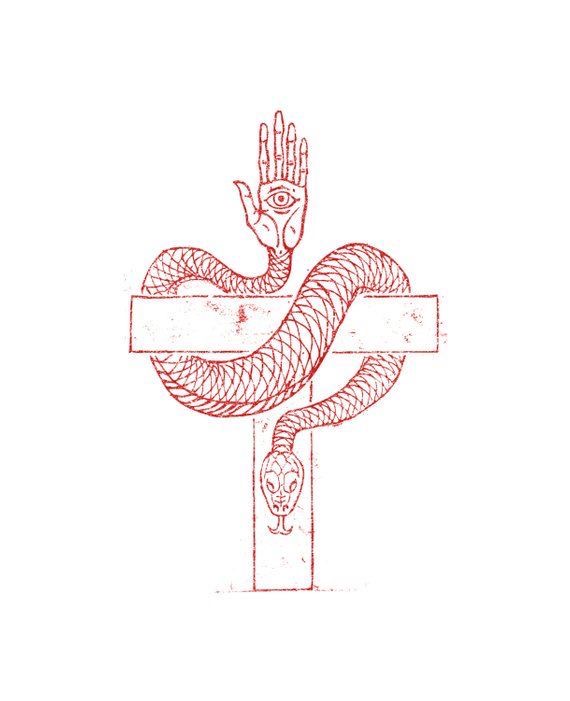
He’s referencing an old story, the one where Israelites in the desert start dying from snakebite, and God tells Moses to forge a bronze serpent and stick it on a pole. Anybody who looks up at it lives. Jesus says that serpent was him. That he’s about to be lifted up the same way, on a cross this time instead of a pole in the sand.
Think about how strange that comparison actually is. The messiah reaches for the serpent, of all available images, to describe his own coming death. Why that one? Why would the bringer of salvation choose to identify himself with the exact figure Genesis blames for bringing knowledge into the garden in the first place?
The Gnostics Who Saw It Differently
Second and third century, cities like Alexandria and Antioch and Rome. There were Christians reading Genesis in a completely different key from everyone else, and their reading flips the standard story on its head. They called themselves Gnostics, from gnosis, the Greek word for knowledge.
Their argument: the God of Genesis wasn’t the real God at all. They gave him a name, Yaldabaoth, the Demiurge, a lesser being who built the material world less as a gift and more as a holding cell. This lower god wanted people kept in the dark, which is why, in the Gnostic reading, he was the one who forbade the tree to begin with.
The serpent, in their telling, came from somewhere higher up. Some said the true God sent it. Some said it was Sophia herself, wearing a different shape for the occasion. Either way, it showed up to break humanity out of ignorance, handing over gnosis, self-awareness, the recognition that something divine was already buried inside every person, waiting to be noticed.
One group took the name Ophites, from the Greek word for serpent, ophis. Another, the Naassenes, borrowed the Hebrew word instead, nachash. Different languages, same instinct: treat the serpent as the one who helped, not the one who ruined everything.
The church came down hard. Condemned the whole movement as heresy, hunted down the communities, burned what writings they found. By the fourth century, most of that literature was gone. And yet the idea kept surfacing anyway, decade after decade, century after century, the way certain ideas just refuse to stay buried no matter how much dirt gets thrown on top.
The Medieval Mystery
Friday the thirteenth, October 1307. King Philip IV of France has every Templar in his kingdom arrested at dawn, all at once, hundreds of knights dragged out of bed and thrown in prison, tortured until they said whatever the interrogators wanted said. One accusation kept surfacing across the trial records: that the Templars worshipped something called Baphomet, described at various points as an idol, a severed head, a demon. Nobody at the time seemed entirely sure what the word even meant, which tells you something about how these confessions were extracted.
In 1818, a scholar named Joseph von Hammer-Purgstall guessed it came from Greek words meaning something close to “baptism of wisdom.” Then in 1967, Hugh Schonfield tried a different approach, using an old Hebrew substitution code called the Atbash cipher, where you swap each letter for its mirror opposite across the alphabet. This isn’t some fringe invention, either. You can watch the Bible itself use this exact cipher, when Jeremiah applies it to disguise the name of Babylon.

Schonfield spelled Baphomet out in Hebrew, bet, pe, vav, mem, tav, ran the swap, and got shin, vav, pe, yod, aleph.
Sophia.
Most historians stay skeptical of this, and that skepticism holds up fine on its own terms. The transliteration is shaky at best, the confessions came under torture, and torture tends to produce exactly the confession the torturer already had in mind, so I wouldn’t stake much on the Templars actually worshipping anything like this. All fair points. But notice how often this particular pattern keeps showing back up across the centuries, whether or not any single instance of it checks out. The hidden name keeps turning out to be Wisdom. The condemned secret keeps turning out to be knowledge.
The Image That Repels and Reveals
- The French occultist Eliphas Levi publishes a drawing that goes on to become infamous, a figure he calls Baphomet. Goat head, heavy curved horns, wings spread out behind the shoulders, a torch burning between the horns, a five-pointed star on the forehead, both male and female features on the same body, one arm raised and the other lowered, and along the arms, in Latin, “Solve et Coagula.” Dissolve and coagulate, the old alchemical formula for turning one thing into another.

Most people who glance at this read it as demonic. Most people still do; at first sight it’s hard not to. Levi claimed it stood for something else, the reconciliation of opposites, male joined with female, spirit joined with matter, good and evil folded into something underneath both categories rather than opposed to either one. He called it hermetic wisdom, the old teaching that every apparent opposite is, underneath, one thing wearing two masks, and that what we perceive as separation is the illusion, not the unity.
A few decades into the twentieth century, Aleister Crowley pushed the reading further. In Magick in Theory and Practice, he wrote that the serpent, Satan, “is not the enemy of Man, but He who made Gods of our race, knowing Good and Evil. He bade ‘Know Thyself!’ and taught Initiation. He is ‘The Devil’ of the Book of Thoth, and His emblem is Baphomet, the Androgyne who is the hieroglyph of arcane perfection.”
Crowley wasn’t hiding what he meant under layers of code. Satan, on his reading, made us like gods by handing us the knowledge of good and evil, taught us to know ourselves, brought us initiation into a higher kind of awareness. The church called him the wickedest man in the world. Given everything else he was saying, out loud, in print, they probably felt they had no choice.
The Divine in Monstrous Form
Look at Hinduism for a minute, because the same pattern shows up there too, and the detour pays off. The most powerful deities in that tradition often look terrifying by design, not by accident. Kali wears a necklace strung with fifty severed heads. Her tongue hangs from her mouth, dripping blood. She stands on corpses, a freshly severed head in one hand and a sword in the other, eyes wild, body dark as night.

But to someone trained inside the tradition, Kali destroys what’s false so that only what’s true is left standing. She cuts away the ego and frees whoever faces her from illusion. The severed heads are the death of that ego. The blood is life force finally moving instead of sitting dammed up somewhere. The darkness is the void that every act of creation eventually has to rise out of.
Shiva lives in the cremation grounds, ash-covered, serpents wrapped around his arms and neck, a third eye burning in his forehead, animal skins on his shoulders, a trident in his hand. Look at him with material eyes only and you see death and ruin. Look with the inner eye and you see supreme consciousness instead, the cosmic dancer, the one who tears down illusion so something truer can stand where it used to be.
And there are the serpents again. They won’t stop showing up. Wrapped around Shiva. Supporting Vishnu while he rests between one cycle of creation and the next. In this tradition, the serpent stands for kundalini, the divine energy coiled at the base of the spine, waiting for the moment it rises and brings enlightenment along with it.
In every one of these cases, the monstrous form is a kind of test. Material sight alone sees a monster and recoils, judging strictly by what’s in front of it. Inner vision looks past the shape toward whatever is actually underneath it. The frightening exterior guards the teaching, in effect, keeping it out of reach of anyone who isn’t ready yet.
Levi drew Baphomet monstrous on purpose, I’d bet on that. The goat head, the wings, the deliberately unsettling blend of male and female. The horror repels whoever isn’t ready, so that only the kind of perception capable of seeing past form ever recognizes what the image is actually pointing at. I think the same logic applies to the serpent in Genesis. Paint it as the villain, make people afraid of it, and only the trained eye ever notices what it really was.
The Secret Doctrine
In 1888, Helena Blavatsky published a massive two-volume work called The Secret Doctrine, claiming to reveal ancient wisdom that hidden masters had preserved across thousands of years. Earlier occultists had mostly hinted at things sideways. Blavatsky just said it outright.
The serpent in Eden, on her reading, was the Logos, the divine word, the bearer of wisdom, the same principle later called Christ, the same principle Lucifer represents once you remember the name simply means light-bearer and has nothing to do with the devil by its own etymology. The serpent didn’t tempt humanity into sin, she argued. It woke humanity up out of animal unconsciousness, handing over what she called the fire of mind: self-awareness, the capacity to think, to question, to actually know something instead of just existing inside a body without ever examining it.
Humans before the serpent, on her account, were innocent the way animals are innocent, which is to say lacking consciousness rather than possessing virtue. There was no moral awareness yet. No self-reflection. No genuine capacity to choose one path over another, because choice requires first recognizing that more than one path exists. The serpent handed them a mind. It awakened them into something closer to being fully human.
Theosophy has a name for this gift: the Manasaputras, sons of mind, divine beings who came down specifically to hand humanity its mental fire.
Blavatsky went on to argue that the same underlying story keeps resurfacing across cultures in different clothes. Prometheus stealing fire from the gods for humanity’s sake. Lucifer bringing light. The serpent offering knowledge. Christ bringing a truth that, in his own words, sets people free.
Physical Sight and Its Limits
The serpent had to look evil. Baphomet had to look monstrous. Kali had to look terrifying. I don’t think that’s incidental, and once you line the three up next to each other, the pattern is hard to miss.
The material eye is arrogant. Not out of malice, just by nature. It assumes whatever it sees is the whole of what exists, judges by surface, mistakes appearance for depth every single time, because appearance is all it has access to.
In John 7:24, Jesus tells his listeners plainly: “Stop judging by mere appearances, but instead judge correctly.” Paul makes almost the same point in 2 Corinthians 3:6: “The letter kills, but the Spirit gives life.” The letter is the surface, the visible form, the outer shell that can mislead you as easily as it can inform you. The Spirit is what’s underneath, the part that actually carries life.
Hindu philosophy has its own word for the world of appearances: Maya, illusion. The world is plenty real on its own terms. What the physical eye registers just isn’t the deepest layer of that reality. It’s a veil, and most people, most of the time, mistake the veil for whatever is standing behind it.
The ugliness of the form, across every one of these traditions, isn’t an accident the story picked up along the way. It’s built into the system on purpose, meant to protect the teaching and filter out anyone not ready to receive it. Only someone whose perception has matured past the surface gets handed the deeper knowledge. Keep people fixed at the level of material judgment, keep them afraid of the exact thing meant to free them, and the teaching stays safe from the people who’d misuse it or simply misunderstand it.
Once inner vision develops, though, the whole picture flips. What looked monstrous turns out to be a teacher. What looked demonic turns out to be carrying something divine the whole time.
What the Tree Actually Gave
The tree gave knowledge of good and evil. The raw ability to make a moral judgment, to tell one path from another, to choose instead of simply obeying because obedience was the only option that had ever occurred to you.
Before eating the fruit, Adam and Eve had no real concept of good or evil. They were innocent the way animals are innocent, lacking awareness rather than holding some higher virtue over the rest of creation. They obeyed because it had never crossed their minds that disobedience was even a category that existed.
The serpent offered them consciousness. Self-awareness. A kind of moral independence. And God himself, in the text, admits it worked. Genesis 3:22 again: “And the Lord God said, ‘The man has now become like one of us, knowing good and evil.’”
They became like God. The serpent’s promise turned out to be true, plainly, without qualification, without some hidden asterisk explaining it away.
So why the expulsion? Why the pain, the death, the hard labor that follows right after? The standard answer is disobedience, and I get why that reading has held up for most people for most of two thousand years. It’s the simpler story. But here’s another way to read the same passage. God expelled them because they had outgrown the garden. A conscious being can’t stay permanently in a state of innocent obedience without that obedience eventually curdling into something closer to captivity. Force them to stay and paradise becomes a cage instead of a gift.
The knowledge they’d gained required them to leave, to step into history, to struggle and choose and suffer and, eventually, grow. Read it this way, the expulsion wasn’t a punishment handed down from above. It was closer to a graduation nobody had signed up for, but that had, in a real sense, already happened the moment they ate.
Sophia Descending
Sophia has always stood for divine wisdom moving downward toward humanity, making people more than they were, handing over knowledge that changes whoever actually receives it.
In Proverbs 8, Wisdom doesn’t stay tucked away safely in heaven. She walks the streets. Calls out at the city gates. Verses four and five: “To you, O people, I call out; I raise my voice to all mankind. You who are simple, gain prudence; you who are foolish, set your hearts on it.” That’s not the voice of an abstract concept. That’s someone standing in a crowd, shouting to be heard.
In the book of Sirach, chapter twenty-four, Wisdom goes looking for a place to actually live among human beings. God tells her to make her home in Israel, and she settles in Jerusalem, in the temple, right in the middle of the people rather than somewhere off to the side.
The Wisdom of Solomon, chapter seven, verse twenty-seven, puts it about as directly as scripture ever puts anything: “In every generation she passes into holy souls and makes them friends of God and prophets.” She doesn’t stay at arm’s length. She enters people and changes them, making them, in some real sense, divine.
The serpent did exactly this in Eden. Offered the same transformation, the same awakening, the same crossing from unconsciousness into consciousness that Sophia offers everywhere else she turns up in scripture.
The Gospel of John presents Jesus as that same divine wisdom, now walking around in flesh, living among ordinary people, teaching, handing over a knowledge of God that changes whoever takes hold of it. John 14:6, about as directly as it can be said: “I am the way and the truth and the life.”
Three Voices
John chapter ten. Jesus is being accused of blasphemy, and the crowd wants to stone him for calling himself God’s son. His defense, in verses thirty-four through thirty-six, deserves a slow read: “Jesus answered them, ‘Is it not written in your Law, “I have said you are gods”? If he called them “gods,” to whom the word of God came, and Scripture cannot be set aside, what about the one whom the Father set apart as his very own and sent into the world? Why then do you accuse me of blasphemy because I said, “I am God’s son”?’”
He’s quoting Psalm 82:6 there, word for word: “I said, ‘You are gods; you are all sons of the Most High.’”
The serpent says you will be like God. God confirms the man has become like one of us. Jesus stands in front of an angry crowd, quoting his own scripture back at them, and says you are gods.
I don’t think he reached for that psalm by accident. He wasn’t claiming some private, exclusive divinity reserved for himself alone. He was pointing straight at a claim already sitting inside the tradition he’d grown up reading. His logic runs something like this: if your own scripture already calls human beings gods, why exactly are you charging me with blasphemy for calling myself God’s son? I’m only saying out loud what your own text already claims about everyone.
He was making godhood something available, not something reserved. And for that, they killed him. Not, on this reading, for claiming to be God in some unique and isolated way, but for insisting everyone shares in that claim. For standing there as the serpent wearing a human shape, holding out the fruit a second time, telling the crowd they don’t need priests standing between them and the divine, don’t need a temple, don’t need any intermediary at all to get there.
Why Hide It
Two thousand years of mystics and heretics kept circling back to some version of this claim, in different languages, at real cost to themselves, over and over, like the idea simply refused to stay dead no matter how many times it got buried.
The Gnostics said it in the second century, and the church fathers wrote against them, called the whole movement dangerous, burned what they could find of it. By the fourth century, most of those communities had been stamped out entirely.
The Kabbalists hinted at it in medieval Spain and Germany, folded into number systems and interpretations passed from teacher to student rather than into open print where anyone could read them.
The Templars may have practiced some version of it in the 1300s, and then, as I mentioned earlier, they were arrested, tortured, burned. Their order dissolved by royal and papal decree, gone within a few years.
The Rosicrucians whispered about it in the 1600s through manifestos written in symbol and alchemical image instead of plain prose. The Freemasons folded fragments of it into their rituals across the 1700s and 1800s. Blavatsky announced it loudly in the 1880s and got mocked for her trouble, called a fraud in print by people who’d barely read her. Crowley said it about as plainly as anyone ever has, early 1900s, and the world called him the wickedest man alive, banned him from more than one country over it.
The secret never actually went anywhere, through all of that. It stayed lodged in scripture, in number, in image, in old languages, there all along for whoever had trained their eyes to see it.
Here’s my best guess at why it had to stay hidden. If people came to believe the serpent was the actual hero of the story, that forbidden knowledge was a gift rather than a trap, that their own divinity was already built in rather than something to be earned through years of obedience, the whole scaffolding of religious authority built on the opposite claim starts to come apart at the seams.
You don’t need saving if you were never actually fallen to begin with. You don’t need a priest if you already have direct access to God. You don’t need an institution standing between you and the divine if the divine was already inside you the whole time.
Here is the uncomfortable reality: an institution that depends on your sense of being broken has no incentive to tell you that you were never broken in the first place. Your guilt. Your belief that you’re cut off from God and need someone else’s help to get back. Take those away and you take away a great deal of what the institution was actually selling.
If the serpent turns out to be the real hero of Genesis, if eating from the tree marked the beginning of wisdom rather than the beginning of sin, if becoming like God was the point all along instead of the crime, then a great deal of what orthodoxy has taught for two thousand years has had the story backward the entire time.
What All This Means
Two thousand years of being told the serpent is the villain.
And yet the numbers land where they land. 358 equals 358 whether anyone likes that or not. The scripture says clearly, you are gods. The mystics kept circling back to the same claim across centuries and continents that had no way of comparing notes with each other. Jesus comparing his own death to the bronze serpent. Paul identifying Christ with Sophia in letter after letter. The Gnostics venerating the serpent as liberator instead of tempter. The Theosophists teaching that serpent and Christ were always the same underlying principle wearing different names for different audiences.
Hindu tradition carries the same structure inside it too, the divine showing up in monstrous form specifically to test whether you’re seeing with material eyes or something deeper than that.
The voice that said you will be like God and the voice that said you are gods turn out, on this reading, to be one and the same voice. The knowledge that makes a person divine was never forbidden by whatever true God actually stands behind this story. Only a lesser, false god had any reason to want it kept back, wanted people ignorant and obedient and easy to manage from a distance.
Orthodoxy painted the serpent as evil for roughly the same reason Levi painted Baphomet as monstrous, the same reason Kali wears a necklace of severed heads. To keep out anyone still looking with material eyes only.
Anyone who only sees with that kind of sight will keep seeing the serpent as an enemy, Baphomet as a demon, the Fall as a catastrophe instead of a beginning. They’ll keep fearing the exact thing they should have been reaching toward the whole time.
Inner vision changes all of it. Learning to look past the surface toward whatever is underneath is, in a real sense, already eating from the tree yourself, whether or not you’d put it in those terms.
The serpent didn’t deceive Eve. It told her something true, and God’s own words in the text confirm as much: the man has become like one of us. Jesus, centuries later, finishes the same sentence: you are gods.
The line runs unbroken, as far as I’ve been able to trace it, from Eden to Golgotha to wherever these words happen to find you.
You could wave all of this off as forced connection, pattern-seeking, reading too much into what’s ultimately coincidence. That’s a fair reaction and I won’t pretend otherwise. It cuts hard against nearly everything most of us were taught growing up, and it turns a good number of inherited values upside down without offering much of an apology for doing so.
Or you could stay with it a while longer and ask what actually follows if it turns out to be true.
If the serpent and the savior are the same figure, what does salvation even mean anymore? Rescue from sin, or waking up to who you already were the whole time? Obedience to an authority standing over you, or the harder, slower work of learning to think for yourself? Faith that refuses to ask questions, or the courage to keep seeking knowledge even after you’ve been told, more than once, that it was never yours to have?
I’ve come to think the deepest spiritual act was never submission. It was inquiry, the willingness to keep asking even when you’ve been warned off the question. Eating the fruit reads to me now like the beginning of human dignity rather than the end of innocence, and knowing good and evil looks a lot less like the thing that disqualifies a person from God and a lot more like the very thing that makes someone resemble him.
The serpent is the savior. The teaching they tried hardest to bury turns out to be the one that mattered most all along.
You were meant to eat from the tree. You were meant to know. You were meant, all along, to become like God.
The serpent promised it. Christ confirmed it. You’ve always been this, waiting, all this time, to remember.
Leave a Reply